Showing posts with label bread. Show all posts

Wednesday, September 17, 2025

The Mystery of the Flour Mill.

Alright, fans of the 1960s television series, Time Tunnel, and the ever-popular English series, Doctor Who; we are going time traveling!  So, whether it’s by tunnel or TARDIS, set your time/location devices to September 1898, Monticello, Utah, corner of 100 South and 300 East….and away we go.  (queue in eerie time travel music).

Ten years after the founding of Monticello, the Monticello Cooperative Flour Mill opened for business.  …and I can hear it now, as I’ve heard it before, “The what!?!  You’re crazy, no such place ever existed in Monticello.”, and you would be thoroughly mistaken in your city’s history.

Referring to Monticello Journal, A History of Monticello until 1937, by Harold George and Fay Lunceford Muhlenstein (and I remember Fay as she was always sweet and kind to me), page 65, “Monticello Cooperative Flour Mill was established in the fall of 1898 with 7000 bushels of wheat waiting to be ground into flour. …3 story structure with red sandstone foundation   …intersection of 1st South and 3rd East.”

Next quote, we need to time travel forward to 1934.  Page 233, “A new Monticello Flour Mill was opened with Chester Black as miller and Lawrence Black as assistant. …old mill destroyed by fire in 1933.  George Adams was part-owner …”Monticello Pride” was the brand.”

The mill ground and processed wheat for flour, a good portion of it being sold to the Navajo Nation down the southern end of San Juan County.  In 1968, the mill was permanently closed after 9-year-old boy scout, Rhett Palmer, died in a tragic, and fatal fall into the machinery.  In 1988, Diane Nielson purchased the property, renamed it the Grist Mill Inn which became a bed and breakfast after extensive renovation.  A photo, by Carl Eisemann, shows what it looked like at the time, and nothing like it looks like now.  (Articles re: Rhett Palmer and Diane Nielson can be found in the San Juan Record’s archives)


The Grist Mill Inn and The Granary are up for sale; hopefully it will be purchased and kept as is, and not torn down or abandoned as so many buildings, with history, have experienced.


Hope you enjoyed that short journey through time, and now to flour, bread and quick bread.

When it comes to baking breads and quick breads (many are cake-like in taste and texture) which flour is the best to use?  All-purpose vs. Bread Flour: bread flour is higher in protein, produces more gluten, so creates a chewier texture and higher rising.  All-purpose is lower in protein, produces less gluten, so creates a softer, more tender texture, and breads will not rise as high as in using bread flour. However, the flours are interchangeable, and all-purpose is more versatile.  What about self-rising flour?  It has baking powder and salt added into the flour, but how much is uncertain.  The texture is lighter than all-purpose flour, so is best for creating biscuits, pancakes and cakes.

For quick breads which can be formed into loaves or muffins, all-purpose flour is the best choice.  The protein content provides a good balance of structure and tenderness, resulting in a moist, consistent, and dense texture.  

Now for some easy and delicious recipes to play with.


Buttermilk Honey Bread

(Bulk of recipe is from page 31; 1995 edition Food for Friends, State Museum of PA; with slight changes due to experience working with this recipe.)

Ingredients:

2 and ¼ tsp. or 1(.25 oz) packet active dry yeast

1 tsp. honey

¾ cup warm water (110 degrees F/45 degrees C)

2 cups buttermilk, room temperature

2 Tbsp. unsalted butter, melted

4 Tbsp. honey

1 Tbsp. salt

 6 and ¼ cups to 7 and ½ cups all-purpose flour or bread flour (different measurement is for low  

                     altitude vs. high altitude)

Canola oil for coating bowl and dough, about 1/8 cup.

Preparation:

In a small mixing bowl, dissolve yeast and honey in the warm water. Let stand until creamy, about 10 minutes.


Combine buttermilk, butter, honey and the yeast mixture in a large mixing bowl. Add salt and two cups of the flour. Whisk well to combine. Add the remaining flour, 1/2 cup at a time, mixing well with a wooden spoon after each addition. When the dough has pulled together, turn it out onto a lightly floured surface and knead until smooth and supple, about 6 minutes.


Lightly oil a large mixing bowl, place the dough in the bowl and turn to coat with oil. Cover with a damp cloth and put in a warm place to rise until doubled in volume, about 1 hour.


Deflate the dough and turn it out onto a lightly floured surface. Divide the dough into two equal pieces and form into loaves. Place the loaves into loaf pans. Cover with a damp cloth and let rise until doubled in volume, about 1 hour.


Preheat oven to 375F. Lightly grease 9”x5” loaf pans.


Bake for 30-40 minutes, or until the tops are golden and the bottoms of the loaves sound hollow when tapped.

Makes 2 loaves.


Homemade Bread May Not Look Perfect and Pretty, But That's Proof it's Homemade.


Using Dark Metal Pans Makes the Sides and Bottoms of the Bread Brown Faster Than the Tops.


Amish Cinnamon Bread (a quick bread)

Ingredients:

Batter:

1 cup unsalted butter, softened

2 cups sugar (or equivalent sugar substitute meant for baking)

2 large eggs

2 cups buttermilk 

4 cups flour (plus ¼ cup for high altitude)

2 tsp. baking soda

Filling and Topping:

Cinnamon-Sugar Mixture:

1/2 cup sugar

¼ cup ground cinnamon

Preparation:

Preheat oven to 350F.  Lightly spray three 8-inch loaf pans with baking spray.


Cream together butter, sugar, and eggs.  Add buttermilk, flour, and baking soda and mix together thoroughly, making sure to constantly scrape down the sides, and from the bottom upwards. 


Fill each loaf pan 1/3 of the way, smoothing out the batter.  Sprinkle 6 teaspoons of the cinnamon-sugar mixture over the batter.  Repeat with remaining batter and cinnamon-sugar mixture.


Batter 1/3 Way Up + 6 Teaspoons Cinnamon-Sugar Mix. 

3 Loaves Ready to be Baked.

Option: Leave as is, or swirl cinnamon-sugar mixture throughout batter with a knife.


Bake for 45-50 minutes, or until toothpick, inserted in center, comes out clean.  Cool in pan for 20 minutes before removing from pan.  


Makes 3 loaves.


Note: To make homemade buttermilk, mix 2 cups whole milk plus 2 tablespoons white vinegar or lemon juice(strained).


Since the Amish do not use electricity, most of their kitchen work is done by hand, using non-electrical tools and gadgets.  To be true to form, I creamed together the softened butter, sugar and eggs using a rubber spatula and hand-power.  The mixture came out as golden colored and creamy just as if I had used an electric mixer.  

Mary Cokenour 


Wednesday, March 12, 2025

A Round and Crusty Old Soul.

Many a time I have written about a world renown comfort food called bread.  Every culture, every country, has a version that dates back historically to when grains were grown, ground and used to feed the community.  So, yes, it is a foundation for the continuance of a society, as is water, but why is it so comforting as well?

Scientifically, bread has a high carbohydrate content which contributes to the release of serotonin.  Serotonin is nicknamed the “feel good hormone” due its ability to regulate mood; namely feelings of happiness, well-being, and contentment.  It also promotes relaxation to induce sleepiness; interacts with cortisol and estrogen for hormonal balance, and influences cognitive functions for better learning and memory.

Remember when, at dinner time, a bread basket was always at the table.  Or, a basket of bread, crackers and butter was served at the table in restaurants.  Serotonin signals, to the body, when it is full, and helps to regulate digestion.  If you indulged the contents of that basket, now you know why you never did finish a complete dinner, and no room for dessert.

Serotonin, and the act of eating, is not all that makes bread comforting.   Baking bread can be therapeutic with its repetitive motions (kneading) which can relieve stress. Baking engages multiple senses of sight, smell, and touch. The aroma is associated with familiarity, tradition, gives a sense of security, and makes you feel pretty darned proud of yourself for creating something so tasty.

The focus of this article will be on Irish Soda Bread, but first a little information about round and crusty breads in general.  A "round, crusty bread" refers to a loaf shaped like a ball with a thick, crispy outer crust achieved through high baking temperatures and steam during the initial baking phase. While the crust of the bread has a firm crunch, the interior is an intricate webbing of ingredients that have been interwoven to create a softer and tender texture.


Types of rounds are the French Boule, Italian Ciabatta, Egyptian Sourdough (sorry San Francisco, but sourdough bread originated, in Egypt, around 1500 BCE), Irish Soda Bread and Basque (Spain) Sheepherder Bread (see San Juan Record, November 20, 2019, for full article).

…and now to my focus, Irish Soda Bread.


Irish soda bread is a quick bread made with baking soda, flour, salt, and buttermilk; no eggs needed. It is a traditional part of Irish cuisine that is often baked in skillets over coals.  Preparation is a one bowl mix, shaping the wet dough into a ball, placed in baking pan, and first baked at a high temperature, then finished off at a lower, yet still high, temperature.  This bread was created out of necessity due to the Irish Potato Famine of the 1800s.  Now here is a very interesting historical tidbit, this bread did not originate in Ireland, but from the Native Americans of the United States of America.  The natives used pearl ash which is a naturally formed “soda” from wood ashes, and acted as the leavening agent.  Their technique and recipe made it back to the Old-World countries, with actual sodium bicarbonate used instead of wood ash.  Sour milk was the liquid ingredient, but was later changed to buttermilk. Buttermilk reacts better with the soda to give an even rise, soft interior texture, and a tangy flavor to the bread.

Eaten plain, Irish soda bread is just that.  However, warmed up, smeared with butter and drizzled with honey, it becomes a perfect light breakfast, or snack for during the day.  It is best used for sopping up gravy and sauce from various dishes, such as stews, chili, and soups.  We even used it to sop up excess sauce from a stuffed shells meal, delicioso!

So, with St. Patrick’s Day coming soon, perhaps a round, crusty Irish soda bread to go along with the Irish stew, or corned beef and cabbage?


Traditional Irish Soda Bread

Ingredients:

3 and ½ cups flour

1 and 1/2 tsp. baking soda

1 tsp. salt

1 and 3/4 cups buttermilk


Preparation:

Preheat oven to 450F. 

Combine flour, baking soda and salt in a large mixing bowl.

Gradually add the buttermilk, stirring with rubber spatula.  If dough is too sticky, add a tablespoon of flour.

When dough is still wet, but not sticky, turn out onto a floured workspace. Shape dough into a ball.  Pat the ball in a round loaf to fit into a nonstick 9-inch baking pan. Place dough inside pan, but make sure it does not touch the sides of the pan.  Score an X on top of the loaf, approximately 1/4 inch deep.


Bake on center rack of oven for 20 minutes.  Do not remove pan from oven, but turn oven temperature down to 400F.  Bake for an additional 20-30 minutes, until the loaf sounds hollow when tapped.  Cool on wire rack before slicing and serving.

Makes one round loaf.

Mary Cokenour


Wednesday, April 19, 2023

Copycat of a Copycat of French Bread Pizza

Way back, in 2019, I was writing up my trilogy on pizza, and the October 9th edition, of the San Juan Record, concerned, not just Sicilian, but French bread style. Even then, the bread labeled, in the local markets, as French bread, was, in fact, just plain, soft, wide loaves of white bread.  But hey, you have to work with what you have, or make it yourself, right?


To make a true French bread pizza, you have to use a baguette which translates to “wand” or “baton”.  Now according to culinary sites, there are four origins to this bread.  #1 – in the 19th century, it was brought to Paris by an Austrian officer, turned baker, August Zang.  He also created pain viennois (a sweet bread filled with cheese, jam or chocolate) and the croissant.  #2 - 1920 French law prohibited bakers from working between 10pm to 4am (strange I know, but it’s the French, so…), so baguettes could be prepared and baked within 3 hours, and during working hours.  #3 - Napoleon Bonaparte ordered local bakers to create this bread for his soldiers, as it was easier to carry in their packs than large round loaves. #4 – management of the Parisian metro asked local bakers to make a bread that was easy to tear with the hands.  Why?  Workers, using the metro, would bring knives, to cut apart hard loaves of bread to eat, on the way to work.  With everyone carrying a knife, well, violence would break out on nearly a daily basis.  Easier bread to tear with hands, meant knives could be banned on the metro, since they were no longer necessary for eating the bread.

Most culinary historians lean towards origins #1 and #2, since French law also dictates that baguettes must be made with only flour, salt, water, and yeast; and must be between 2-3 feet long, and 2 inches wide.  Which now makes me wonder, “Did the creators of Star Wars see two people dueling with baguettes, and light sabers were born?”

Now to Panera aka St. Louis Bread Company, founded in 1987, Kirkwood, Missouri, and their newest edition to the menu, Toasted Baguette Sandwiches.  The first commercial I saw was of a pepperoni pizza style, extremely similar to French bread pizza, like Stouffer's, but both sides of the bread placed together.  However, the “baguettes” they use are only one foot in length, yet still 2 inches wide; so, a baby baguette that still needs to reach its maturity?  The point is though, that Panera was making a copycat version of a Stouffer’s frozen item.

…and there I was, at Blue Mountain Foods, and what did I find in the artisan bread display?  Full Circle Market brand, take and bake, twin set of baguettes, and this is a very tasty product indeed.  At 400F, for 10-15 minutes, the outer crust becomes crisperty-crunchity; smear butter on the hot and soft inside, and it is quite easy to eat a complete loaf for a meal.  Ahem, yes, I am speaking from experience, and not ashamed of it.

But here was the question, could I create a copycat version of Panera’s Pepperoni Mozzarella Melt?  Heh, most of you know that the answer is definitely, “Of course I can!”


Setting the oven to preheat at 400F, I split a baguette, lengthwise, down the middle.  First a good coating of homemade pizza sauce, getting as close to the edges as possible.  Second, a generous helping of shredded mozzarella cheese.  Third, sliced pepperoni from end to end, but only on one side of the split loaf.  Now while a plain loaf would take 10-15 minutes to bake, with the toppings, it took almost 20 minutes for the cheese to fully melt, and the pepperoni to develop a crispiness around the edges (how we like it).


The cheese only side placed on the pepperoni layered side, and there it was, the pepperoni mozzarella melt, without having to go to Panera to purchase it (and a lot cheaper to make too).

The taste was fantastic, especially being homemade with love and passion; alright, and wanting to quiet a rumbling stomach.


Moral to this entire story?  If you want something badly enough, but cannot purchase it outright, then make a copycat version…period!  This is also a great way for families to get together, and have fun learning to make favorite restaurant foods.  Not only is cooking or baking learned, but accounting measures such as cost and budgeting.  Education via eating, who knew!

Mary Cokenour


Wednesday, August 10, 2022

Always a Good Reason to Eat Strawberries.

"Strawberries, strawberries, every year

These must be eaten, enjoying here

Even the best cakes allow it when

Made in kitchen, the cook will be then

Baked with love, served with pleasure"


Strawberry Strawberries Forever

Sung by: Anne Lemmen

Written by: Ingeborg Bauer

Available Only At: Amazon Music


Strawberries are a deliciously, unusual fruit; unusual due to their structure.  With the variety of fruits and vegetables grown throughout the world, the strawberry is the only fruit with seeds on its outside, approximately 200 of them.  Due to this feature, botanists call the strawberry a false fruit, aka pseudocarp, since they look at it as a “fruits within a fruit”, and not a simple berry at all.

Consumer wise, we tend to see strawberries make a huge appearance in supermarkets around April.  While they are available year-round, prices vary due to the quantity available, where they were shipped in from, and method of growth (fields or greenhouses).  Being a cool weather plant, home growers plant April to May, or mid-spring; first harvest is typically June, with a second harvest occurring in the early fall.  With the high heat of July and August, like humans and animals, these plants shy away from the scorching sunlight.

In a very detailed, scientific 2019 study done on the nutritional and health benefits of strawberries (https://www.ncbi.nlm.nih.gov/pmc/articles/PMC7202899/), “Strawberries, are a rich source of nutrients that helps reduce the risk of type 2 diabetes. The nutrients lower the post-meal spike in blood sugar and insulin in adults with obesity or excess weight who have insulin resistance or metabolic syndrome.”  In a Medical News Today article (https://www.medicalnewstoday.com/articles/271285), “Strawberries are rich in vitamins, minerals, fiber, and compounds with antioxidant and anti-inflammatory properties.”  In layman’s terms, this fruit is really, really healthy for the human body!

That is if you eat them plain, no dipping in sugar, whipped cream or chocolate.  No adding into baked desserts loaded with high carb ingredients like flours and sugars; and if they are, moderation is the key word.

When it comes to purchasing fresh strawberries, I personally tend to wait for the sales, and buying, what others would say, is way too much.  Why?  To process them into manageable savings of course!  Removing the leafy top and center white part, place on a parchment paper-lined baking sheet, and freeze until solid, at least 30 minutes. Transfer to a resealable freezer bag, and store for up to 3 months.  Baked goods, such as muffins and quick breads, should be individually wrapped in plastic, and can be frozen up to 2 months.

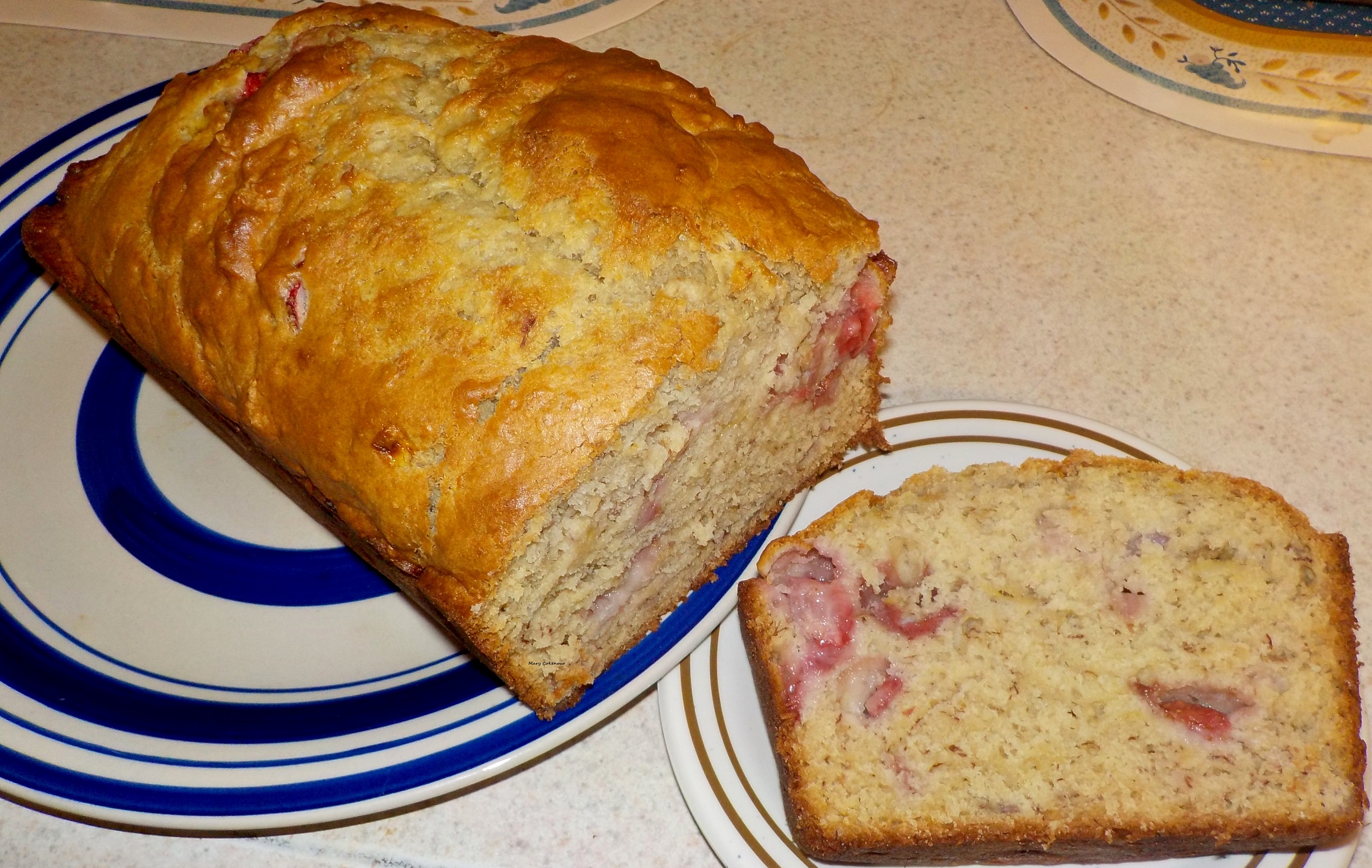
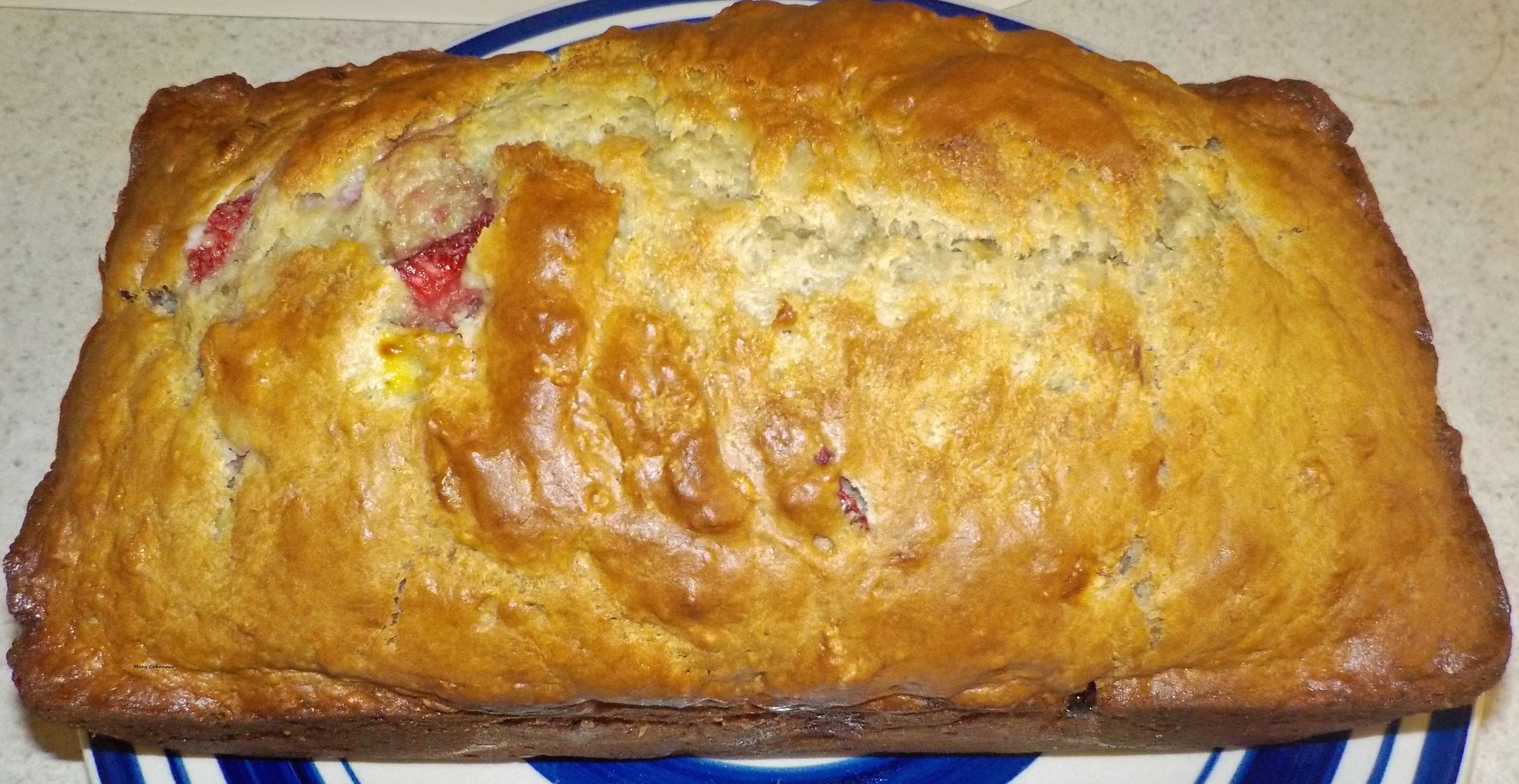
So, it came to pass that, once again, I had overripe bananas waiting to be, frozen, or baked into bread.  At the same time, there were enough strawberries remaining, just about to enter their “icky” phase of ripening, so what did I do?


Strawberry Banana Bread

Ingredients:

2 and 1/2 cups all-purpose flour (add 3 Tbsp. for high altitude)

3/4 tsp. baking soda

1/2 tsp. salt

4 Tbsp. unsalted butter, melted and cooled

3/4 cup sugar

3/4 cup (6 oz. container) vanilla yogurt (or sour cream and increase vanilla extract to 4 tsp.)

2 eggs beaten

3 overripe bananas, mashed well

2 tsp. vanilla extract

1 cup thickly sliced, or large dice strawberries   

Preparation:

Preheat oven to 350 degrees and spray a 9”x5“ loaf pan with baking spray.


In a medium bowl, whisk together the flour, baking soda, and salt.

In a large bowl whisk together the butter and sugar. Then whisk in the yogurt, eggs, bananas, and vanilla.


Gradually add dry ingredients to liquid ingredients, folding them together until just combined; do not overmix.  Gently fold in the strawberries. The batter will be very thick, but loose.


Pour the batter into the loaf pan and bake for 55-60 minutes, or until a toothpick, inserted in center of the bread, comes out cleanly.  Remove pan from oven and let bread cool for 10 minutes in the pan. Remove bread and transfer to a cooling rack for an hour before slicing.


Store in plastic wrap; bread will last up to 3 days in refrigerator, or 2 months in freezer.

Makes one loaf.

Think of it this way, all these yummy bread recipes I have been sharing is increasing your recipe card file.  The holidays will be here sooner than later, and homemade baked goods make great gifts!  …and yes, you can substitute with blueberries, blackberries or raspberries; still a one cup ratio, or 1 and ½ cups, who keeping score, right?

Mary Cokenour