Showing posts with label candy. Show all posts

Wednesday, July 23, 2025

What is Your Torrone Mood, Hard or Soft?

One of the great advantages, of being raised in an Italian/Croatian neighborhood, is not just experiencing two cultures, but sampling the variety of foods. Not everyone has the financial benefits of being able to travel the world, to experience what each country has to offer visitors.  However, traveling around these United States, you can basically get many of the same experiences; remember, we are a very diverse melting pot of humanity.

One of the largest celebrations, in Italian culture, is the Feast of San Gennaro.  In New York City, in September, it is an eleven-day event, within Little Italy, featuring live musical performances, parades, religious processions, vendors of every type, but foods are the major sellers.  Over one million people flock to Little Italy to enjoy this celebration of Italian heritage and culture. 

If not in a New York state of mind; don’t let Billy Joel hear that, then consider vacationing in Las Vegas, Nevada; South Florida (Tampa and Hallandale Beach), or the Georgetown area of Seattle, Washington, again, in September.  Of course, I am biased, and will push the NYC celebration before any of those other areas.

What are the typical foods being sold by the vendors during the feast? 

-Sausage and Peppers: Grilled Italian sausage with sautéed peppers and onions, typically served on a roll.

-Zeppole: Deep-fried dough balls, often covered in powdered sugar.

-Cannoli: Crisp pastry tubes filled with sweet ricotta cheese.

-Arancini aka Rice Balls: Large, breaded and fried balls of rice, often with a savory meat filling.

-Other Italian Dishes: Pasta dishes, pizza, and various Italian desserts and sweets.

-Ethnic Foods: The festival also features foods from other cultures, reflecting the diverse culinary landscape of NYC.  This is what I am speaking about when I say, you can experience the cultures and foods of the world, just by visiting our own United States!

Now that I have you all drooling, time to talk about a favorite Italian candy, sold at feasts, given out at weddings, and packed into Christmas stockings…Torrone.

Torrone has origin stories tracing back to Greece and the Arabian countries, but it is Italy that takes full credit for its creation.  In 1441, Bianca Maria Visconti married Francesco Sforza, and became the Duchess of Milan.  Legend states that, at the wedding in Cremona, Italy, a candied confection was served in the shape of The Torrazzo, the bell tower of the Cathedral of Cremona. Hence the name, however, it is more likely named after the Latin verb "torrere," which means "to toast", and refers to the traditional method of toasting almonds, a key ingredient in torrone.


Torrone is primarily made from honey, sugar, egg whites, and toasted nuts, most commonly almonds or hazelnuts. Other additions include pistachios, walnuts, and added flavorings such as lemon zest, orange zest, or vanilla extract (pure form only, nothing less will do).  The texture of the candy can be hard and crunchy (duro), or soft and chewy (morbido); it all depends on the proportion of ingredients and the cooking process.  Once cooled, the candy can be cut into a variety of small shapes which can be wrapped individually; or into a large block that can be cut apart later on.  The taste has a rich, sweet, nutty flavor that may be enhanced by the addition of the lemon, orange or vanilla flavorings.  It can even be coated in chocolate after cooling and cutting!

Torrone is a very sticky and messy confection, so rice aka wafer paper is used to hold it together.  The rice paper is made from potato starch and water, has a negligible flavor, so does not interfere with the full flavor of the torrone.  Without the rice paper, the nougat would stick to everything, and be impossible to cut, even after cooling.


Those of you who enjoy creating homemade candies might want to give the following recipe a try.  Otherwise, torrone is available via online shopping, and during the winter holidays, make sure to push your local stores to get the product onto the shelves.  Santa Claus will be so impressed, he might just give you an extra special present in your stocking.

So, enjoy a taste of torrone, whether you create it yourself, purchase it, or even have the blessed opportunity of traveling to the Feast of San Gennaro.  September is not that far away!


Classic Italian Torrone

Ingredients:

2 sheets edible wafer paper (rice paper), trimmed to fit your pan.

3 cups almonds (whole, blanched), roasted.

1 cup pistachios, roasted (this can be optional, or use hazelnuts)

1 and ⅓ cups honey.

1 cup + 3 Tbsp. sugar.

2 large egg whites, at room temperature.

¼ tsp. pure vanilla extract.

⅛ tsp. kosher salt.

1 Tbsp. lemon zest or orange zest (optional).

Preparation:

Prepare the pan: Line an 8x11-inch baking dish with plastic wrap and place one sheet of wafer paper on the bottom.

Roast nuts: Roast at 350°F for 8-10 minutes until fragrant and keep them warm. (see Notes below).

Cook honey and sugar: Combine honey and sugar in a pot and cook over low heat for about 30 minutes, stirring constantly, until smooth. (See Notes below).

Whip egg whites: Whisk egg whites and salt until soft peaks form. Combine mixtures: Gradually whisk the whipped egg whites into the warm honey mixture in batches.

Thicken the nougat: Continue cooking the mixture over low heat, stirring constantly for about 40 minutes, until it turns brighter white and thickens. A small amount dropped in ice water should feel like soft clay.

Add flavor and nuts: Whisk in lemon zest and vanilla, then add the warm nuts and stir.

Set the torrone: Transfer the mixture to the prepared dish, smooth the top, and cover with the second sheet of wafer paper. Press down gently.  Be care, the mixture will be hot!

Cool and cut: Let cool at room temperature for 1-2 hours until firm. Remove from the pan and cut into 1-inch squares with a serrated knife.

Notes:

Patience and continuous stirring are essential, especially when cooking the honey and sugar and thickening the nougat; use a candy thermometer for accuracy. Soft torrone is made with a lower temperature, around 280-290°F, while hard torrone requires a higher temperature, around 295-315°F.  Work quickly as the nougat cools and thickens fast.

Wafer paper can be difficult to find; parchment paper or greased plastic wrap can be used instead, but must be removed before eating as these are not edible.

The roasted nuts can be chopped into smaller pieces instead leaving whole.  Then they can be spread more evenly throughout the nougat.

Mary Cokenour 


Wednesday, January 1, 2025

Be An Open Book.

There are three ways to get to know what a book is all about.  Look at the cover only and form a conclusion based upon no factual information.  Read the tease on the inside, or back, cover and form a conclusion based upon rumor or gossip.  Read the entire book, beginning page to ending page, and form a conclusion on every point of factual information.

As a species, humans are comfortable when they can label each other.  That way, they can place an individual into a box or file folder, and know how to deal with them without stress.  It is also a form of protection; you know who is just like you, and who to be cautious of because they are different from you. This is what happens when only the person’s outward appearance is looked at, what is “heard” about this person, or garner facts by speaking, and getting to know, someone.

In cooking and baking, the same kind of “judgments” can be made.  Does the food look appetizing?  Many, if the answer is no, will not try the dish.  The same happens if only a little knowledge is known about the ingredients.  Who wants to put something into the mouth, only to spit it out again, and no one looks graceful doing that.  But, as I have stated before, life is an adventure, fear is the mind killer, and sometimes you just have to take the plunge.

Take, for example, the recipe I am about to give you, Mint Balls.  It is a small round cookie, very plain on the outside, but inside it is packed with mint and chocolate.  Sort of like Doctor Who and his Tardis; it looks like a small police call box, but inside it is immense.

Mint and chocolate are an enticing combination of coolness and rich decadence.  Remember the commercials for York Peppermint Patties, where someone bites into a patty and goes into another dimension of sorts.  This combination is not a 20th century creation, but dates back to the 16th century.  European explorers returned from the “new world” with cacao beans which were used to make a beverage by the indigenous people.  However, the drink was very bitter, so spices and herbs, one being mint, were added to make it more palpable.

The York Peppermint Pattie originated in 1940 at the York Cone Company, York, Pennsylvania, owned by Henry Kessler.  The concept developed due to consumers requesting a softer type of mint candy, but how to keep it from melting into a gooey mess.  The peppermint mixture was given a granular texture, then covered in a thick coating of dark chocolate.  Kessler’s company was eventually bought out by the Hershey Chocolate Company, Hershey, Pennsylvania, in 1988.

A rival candy to the Pattie was Junior Mints, developed in 1949 at the James O. Welch Company of Cambridge, Massachusetts.  The idea was to make a peppermint patty that could be eaten in one bite, and had a creamier texture inside.

Other popular brands you may have tried, or simply heard about, are: Andes Candies, After Eight, Ghirardelli Squares, Lindt Balls, Dove and Palmer’s.  Ghirardelli, Lindt and Palmer’s also make peppermint bark which only comes out for the winter holidays.  So, if you do not have a clue as to what gift I will be expecting, you will not go wrong with peppermint chocolate candy.

Now here is the recipe for Mint Balls that I mentioned earlier on.  By the way, this recipe appeared in the Food for Friends cookbook, published 1995 by The Friends of The State Museum of Pennsylvania.  It was created to raise monies for the support of the museum, and my recipe was recreated during a PBS special about the museum, and the cookbook.

Happy Holidays!


Mint Balls

Ingredients:

1 cup butter, softened

½ cup confectioners’ sugar

1 tsp. vanilla extract

2 and ½ cups all-purpose flour

¼ tsp. salt

3 dozen “Junior Mints” candies

Preparation:

In a large bowl, cream together the butter, sugar and vanilla extract; slowly add the flour and salt to the creamed mixture.  Cover and chill till the batter becomes firm, but manageable.

Preheat oven to 350F.

Take the batter by teaspoon, place a candy mint in the center, and form a ball around it.  Place on ungreased cookie sheet (Air Bake is the best for baking), and continue forming balls.

Bake for 10-12 minutes; cookies will be lightly browned.

Let cool; can be eaten as is, or rolled in confectioners’ sugar.

Makes 36 cookies.

Note: before baking, the balls can be rolled in crushed nuts; and if you are seeing the pun, then have a great laugh.

Mary Cokenour


Wednesday, December 11, 2024

An American Culinary Blunder.


Candy Cane Fudge, Chocolate Mint Fudge, Divinity Candy

From experience, coming up with recipes in the mind, figuring out ingredients and putting it all together can be either delicious success, or “what the heck was I thinking!” failure.  However, once in a great while, a recipe seeming to go wrong ends up creating an amazing yummy mistake.

Take, for example, the origin of the smoothly decadent candy known as Fudge.  When someone exclaims “oh fudge it!”, the word fudge is substituted for the naughty “f” word.  The term “fudged” refers to the failure to successfully complete a goal, the act of cheating, or substituting something that eventually completes a goal, just not the way originally intended.

Fudge is a completely American mistake from the 19th century.  While its origin seems to have occurred in the 1880s, the name of the confectioner who made the mistake is not known.  However, he, somehow it was known he was a he, was attempting to cook up a batch of French style caramels to sell for Valentine’s Day.  However, he ended up overcooking the ingredients which resulted with a smooth creamy confection that became known as fudge.  Why the name fudge?  Cause he fudged it! (insert canned laughter, and snorting equal to a face palm)

One of the earliest written accounts of making fudge was from Emelyn Battersby Hartridge, a student at Vassar College, in Poughkeepsie, New York.  In 1886, she cooked up 30 pounds to be sold at a college auction.  Later on, it became a trend for women attending college to cook up pots of this sweet treat, in their dorm rooms, whether rules allowed or forbade, it did not matter.

By the 20th century, fudge had become so popular that the recipes were being shared overseas in countries like England, Scotland, Wales and even France. Of course, since it was a mistake in crafting French caramels that created fudge, the French call the two confections, “cousins”.

So, how exactly is fudge made? Fudge is made with sugar, milk or cream, butter and added flavorings, the most popular being chocolate.  The base for fudge is boiled until it reaches the soft-ball stage (135 to 140 degrees F), then stirred or beaten as it cools to minimize the formation of sugar crystals. The result is creamy and smooth semi-soft, yet dense, texture, but a hint of sugar crystals is not a bad thing. After cooling, it is usually cut into slabs or bite-size squares.  While boiling, no matter how much you want to, do not stir the mixture until it reaches the soft-ball stage.  Otherwise, it will become a grainy mess of crystallized sugar.

Making fudge from scratch is a time-long process, so, of course, dessert companies, and home cooks, came up with easier ways. Three brand name companies, Carnation, Nestle and Eagle Brand simplified fudge making by introducing sweetened condensed milk into their recipes. Only trial and error will tell you which recipe is good, better and best. 

Kraft Jet-Puffed Marshmallow Crème has a recipe on the jar label for fudge, so it is not just for making the classic “fluffernutter” sandwich.  The original recipe for “Fantasy Fudge” contains walnuts, but another nut can be used, or leave them out altogether.  Use the recipe as a basic guide and experiment with other types of add-ins.

Fantasy Fudge

Ingredients:

3 cups white sugar

¾ cup butter or margarine

⅔ cup evaporated milk

1 (12 oz.) bag semisweet chocolate chips

1 (7 oz.) jar marshmallow creme

1 cup chopped walnuts

1 tsp. vanilla extract

Preparation:

Gather all ingredients.

Grease a 9x13-inch pan.

Mix sugar, butter, and evaporated milk in a large, heavy saucepan over medium heat, stirring to dissolve sugar. Bring mixture to a full boil and cook for 5 minutes, stirring constantly.

Remove from the heat and add chocolate chips; stir until chocolate chips are melted and mixture is thoroughly combined.

Stir in marshmallow creme until incorporated. Mix in walnuts and vanilla.

Transfer fudge to the prepared pan and use an offset spatula to spread out and flatten.

Let cool for at least 1 hour before cutting into squares.

Yield: 3 pounds.

Luckily, if candy making is not your thing, fudge is offered, for sale, in various candy shops across the nation, and Utah is no exception.  A few retailers that offer online sales: Wasatch Fudge, Fudge Co., Brittles & Fudge, Startup Candy Company, Fernwood Candy, and the list goes on.  If you live in an area that has an authentic candy shoppe, and most specially creates their own inhouse, then consider yourselves very blessed in the sweet tooth department.

Now what candy is called fudge, is not a fudge at all, but its taste as been likened to the divine?  Divinity fudge is actually a candy with a texture closer to Turkish Delight, marshmallow or a very soft nougat.  Its origin, well the first appearance of a recipe, can be traced back to 1902 and the Corn Products Refining Company with their introduction of Karo corn syrup.  Supposedly the taste was said to be “Divine!”, and the name stuck.  This candy is made by cooking sugar and corn syrup together until firm, then beating egg whites into it.  Add-ins can be nuts, chocolate, coconut, and candied fruit, but since pecans are the most popular, it is often called “Southern candy”.  Replacing white sugar with brown sugar, plus adding vinegar and baking soda, results in a confection called "sea foam"; a crunchy, airy candy similar to meringues.

Will fudge be on the holiday sharing list this year?  Only Santa Claus knows for sure.

Mary Cokenour


Wednesday, May 31, 2023

The Mysterious Creation of Peanut Brittle

When I write about new recipes and food items, enjoyment does come from looking back in history, and finding out how it came about. Many origins are straight forward, and then there appears one that boggles the mind.  While researching the origin of peanut brittle, well, the origin stories need to be taken with huge grains of salt.  Alright, maybe the second story is more plausible, but still.

Here goes, the first origin theory goes back to before merry old England was even thought of as England.  The Celts (no, not the Boston Celtics; sometimes I really hate Google) lived during the Iron Age, from about 600 BC to 43 AD; this is when iron was discovered and developed into tools and weapons.  The Iron Age ended when the Romans invaded Britain and set up fortresses, took over established villages, and forced Christian religion and Roman government onto the locals. At that time, the people were not called Celts (that name was given in the 1700s), but the Romans sent back stories of the people they referred to as Druids.

Now here is where the origin becomes a bit mucky.  The Celts, and it is unclear if this is before they were named Celts, or after, thought to have served the brittle during holidays. They made the sheet of candy by baking a mix of sugar and peanut butter. The candy then made its way from Europe to America in the 1830s by way of Irish settlers coming to the New World. However, peanuts are not native to the British lands.  They came to Europe, via Spanish and Portuguese explorers, in the 1500s. They were very popular in Africa and Asia, but did not become popular in the UK until the 1800s.  So, did the Celts, who were not Celts until the 1700s, begin making peanut brittle between the 1500-1600s, or afterwards during the 1700-1800s?  Of course, no one really knows.

Now to the second origin story which takes place in the United States’ deep south.  During the Civil War soldiers survived on peanuts because of its high protein content, were easily transported, and the shells were natural waste.  After the war and the reconstructionism of the south, peanut farming found its niche, and became a huge commodity.  Around the year 1890, a Southern woman (unnamed) created peanut brittle by mistake. Apparently, she was making taffy, added baking soda instead of cream of tartar.  Waste not, want not, she continued cooking the mixture which resulted in a crunchy brittle, instead of a chewy taffy. 

But wait, there is one more story which deals with a “maybe he was, or maybe he was not” a real person in history.  Tom Beaver, a West Virginia woodsman and lumberjack, who was often associated with Paul Bunyan, supposedly created peanut brittle.  A leak had erupted in a dam, and a town was in danger of being flooded, destroyed and many lives lost.  Tom created a goopy concoction of peanuts and molasses, plugged up the leak, and the town and people were saved.  He gave the “recipe” to the people, and they, in turn, cooked it up into a tasty treat.

Originally, peanut brittle began with a sugar and water mixture, but other sugary liquids began to be used; many adding unique flavoring.

What can be used instead for peanut brittle?

 -corn syrup.

-honey.

- light molasses.

- agave nectar.

-brown rice syrup.

-maple syrup.

One of the most delicious peanut brittles I have ever eaten came from Honeyville, in Durango, Colorado.  It was light, airy, crispy and had such an addicting flavor to it; and nope, the recipe was not available to the public.

After experimenting with an easy recipe, I did find, here were the conclusions.

Honey: A lighter-flavored honey works better, especially if you do not like an aggressive honey flavor.  

Texture: While it is initially a crispy candy, even stored in an air-tight container, the candy does soften up into a smooth treat that does not stick to the teeth when eaten.  A huge plus!

Samples were given out, and not one complaint; instead, the recipe was requested.  Whether completely crunchy, or it has softened up, I am declaring this peanut brittle a winner!

Hint: With the recipe I will share, it calls for two cups of honey.  To obtain, and keep, that crunchy texture that most enjoy, use one cup honey with one cup corn syrup instead.


 Honey Peanut Brittle


Ingredients

2 cups honey

1⁄4 cup water

1 and 1⁄2 cups raw peanuts (roasted and salted nuts can be used, skip 1/8 tsp. salt))

1and 1⁄2 Tbsp. butter

2 tsp. baking soda

1 tsp. vanilla

1⁄8 tsp. salt (skip if roasted and salted nuts used)


Preparation:

Line a large rimmed baking sheet (aka jelly roll pan) with baking parchment paper, a silicone baking liner, or butter very well. 


Combine the honey and the water in a 3-quart saucepan.  Boil, on medium-high heat, until it reaches the hard crack stage; remove from heat. (See Notes).


Add the rest of the ingredients; mix thoroughly.  Pour mixture from saucepan onto sheet, spreading thinly.  Wait until brittle is hardened and totally cool to the touch (20-30 minutes); break into pieces.


Makes about 2 lbs. or 16 servings of one ounce (about 1/4 cup)


Notes:

The hard-crack stage is the highest temperature (300° F–310° F) you are likely to see specified in a candy recipe. At these temperatures, there is almost no water left in the syrup.  It will take a good 25-30 minutes to reach the temperature. Drop a little of the molten syrup in cold water and it will form hard, brittle threads that break when bent.

After hardening and cooling, if the brittle is still somewhat soft and sticky, place pan in a preheated 325° F oven for 5 minutes to harden up completely.

Peanuts: Spanish or Virginia. The skins add a deeper nut flavor and a lovely light brown color to the brittle. However, remove half the skins from the peanuts, or the mixture will become too “gunked” up and be difficult to process correctly.   Almonds, Cashews, Pecans, Walnuts or Pepitas can also be used.  With the larger sized nuts, chop up before using.

Mary Cokenour


Wednesday, December 22, 2021

Candy to Cookie Conversion.

“Sometimes you feel like a nut.

Sometimes you don't.

Almond Joy's got nuts.

Mounds don't.”

(Written by Leo Corday and Leon Carr and sung by Joey Levine)


Whether you enjoy eating coconut, or not, when this commercial for Peter Paul’s Almond Joy and Mounds candies comes on, bet you find yourself singing along.
  While the Mounds bar was a huge hit, with the military, during WW2; Almond Joy has been around just as long.  Originally called the Dream Bar, the candy confection was a mixture of sweet coconut and diced almonds, encased in dark chocolate.  Once the Peter Paul Company purchased it though, the name was changed, along with the almonds.  Instead of diced almonds mixed in, two whole almonds were placed atop the coconut, making each whole piece a two-bite candy.  Now owned by Hershey, the current slogan for Almond Joy is “Unwrap Paradise”, and that would definitely make it a dream bar, once again, if it gave us paradise.

From the professional baker to the homemaker, it is not unusual to try and create a bake good, from the perspective of a candy.  Perusing the internet, many a recipe can be found where a cake or cookie has been created to resemble a brand name candy.  Snickers cheesecake anyone?  So, is it any wonder that Almond Joy is now an easy to bake, 4-ingredient cookie?  In fact, the recipe is so easy, that the almonds and semi-sweet chocolate chips can be swapped out for other types of nuts and chips.

Alright parents, the children are home from school for the winter holidays, and they will enjoy making these cookies with you.  With the main ingredient of coconut, think about making these for Easter as well, if you cannot find, or make, coconut crème eggs. 

Oh, and I took this recipe one step further than just swapping ingredients; dipping the bottoms in melted chocolate!  Want to go even further, drizzle that melted chocolate over the cookie.  With chocolate, more is always more!  I recently made two separate batches, and a half of each batch was dipped in either dark or white melted chocolate.  I have received requests to, “Please make more, and they were so good!”  If you needed independent endorsements of this recipe, now you have them.


Recipe for Almond Joy Cookies

(Note: I could not find the origin of this recipe.  Each food site/food blog I checked claimed to be the originator of this recipe.)

Ingredients:

1 (14 oz.) bag sweetened coconut flakes

2 cups semi-sweet chocolate chips

2/3 cup chopped almonds (lightly salted is preferred, but I used salted and still came out great)

1 (14 oz.) can sweetened condensed milk

Preparation:

Preheat oven to 325F.  Line aluminum/metal type baking sheet or pan with parchment paper (Note: this is a must if you want the cookies to cleanly come off the pan without crumbling.  Using silicone mats, or lining with wax paper, will cause the cookies to melt completely flat.)

In a large bowl, combine all ingredients; stir until well combined.  Using a 2-inch ice cream scoop, place a dozen mounds on the parchment paper.  Have a small bowl of water nearby to moisten tips of fingers to slightly flatten down the mounds, and firm up the round appearance.(Note: if using a 1 and ½ inch cookie scoop, 3 and ½ dozen cookies will be created)


Bake cookies for 12-15 minutes, or until cookies turn golden brown.  Let them completely cool on the parchment before removing; they will peel off easily.  Store in airtight containers.


Makes 3 dozen.


My first batch was using this original recipe.  The second batch, I swapped out the almonds for chopped walnuts, and used cinnamon chips instead of semi-sweet chocolate chips.  Again, 3 dozen cookies from the mixture.


Then I melted 2/3 cups of dark chocolate and white chocolate coating, in separate bowls (Ghirardelli brand, or almond bark works too).  I did intervals of 20 seconds, in the microwave, stirring after each interval, until completely smooth.  For the original recipe, I dipped half the batch in the dark chocolate.  For the walnut/cinnamon chip half batch, those were dipped in the white chocolate.  The cookies were placed, chocolate dip side down on wax paper and let cool until the chocolate hardened.


While the undipped cookies were definitely delicious, the dipped cookies went to a whole other level of awesome!  A simple 4-ingredient cookie which has so much potential to be more, depending on what ingredients are inside your baking pantry.  Bake ‘em up and have fun!

Mary Cokenour


Wednesday, December 15, 2021

Dear Santa, Please Fill My Stocking with Chocolate.

I like chocolate.  No, let me correct that. I LOVE CHOCOLATE!!!  Glancing at the typical food pyramid, one of the missing food groups is chocolate; the other is pizza. 

Cacao, by itself, is bitter, but the addition of fats, sweeteners and flavorings develop it into chocolate.  Eaten, in moderation of course, cacao is good for the heart. The beans are full of phytonutrients which act as antioxidants, and are rich sources of iron, copper, magnesium, zinc and phosphorus.

Chocolate as brain food?  In 2016, a study on Alzheimer’s patients was performed.  A group of 400 were given slight, moderate or large amounts of a chocolate snack, weekly.  Those of the moderate group saw a 40% decline in the illness, as opposed to the other groups.  (Journal of Alzheimer’s Disease: https://content.iospress.com/articles/journal-of-alzheimers-disease/jad160142)

Mood elevation?  Personally speaking, if I am feeling a bit blue, sad, angry, or frustrated; I reach for a mini, maybe even a fun size, bar of one of my favorites.  Opening the wrapper, letting the smooth chocolate melt on the tongue, and the sigh of contentment comes.  It is not just a feel good time in the mouth, but it is an overall feel good.  Now, can one get high eating chocolate?

Chocolate contains substances that stimulate a euphoric mood in the brain, just as cannabis does.  Anandamides, and substances that have similar effects as amphetamine, such as tyramine and phenylethylamine, lift up our mood, but calms it as well.  To get a high though would require consuming 20 pounds of dark chocolate!

If anyone is truly interested in chocolate’s history, types and production of popular brands, I recommend reading Chocolate Facts, Effects & History, by Jessie Szalay (Live Science, March 27, 2018: https://www.livescience.com/61754-chocolate-facts.html)

For occasions like holidays, birthdays, anniversaries, or any other special moment, boxes, or filled gift baskets, come with an assortment of fine chocolates.  The popular brands often advertised are Lindt, Ghirardelli, Godiva, and even Cadbury (some American candies are copies of these British confections).  Which got me to thinking about, “What does Utah have to offer in the chocolate department?”


Search, Purchase, Sample, Review.

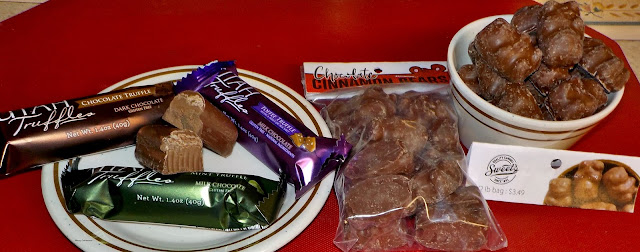
In Monticello, I was able to find, at Blue Mountain Foods, Utah Truffles (https://utahtruffles.com/), each bar costing a reasonable price of $1.29.  Flavors available are Chocolate, Mint and Toffee; ordering from the company itself though will offer more variety.  100% gluten free, using all natural ingredients, the truffles are covered in a smooth chocolate.

The center is creamy, with the flavor coming through, slight at first, and intensifying with every little bite.  This is a truffle bar that is not to be gobbled, but eaten nibble by nibble to have an ultimate chocolate experience.

Available at the San Juan Record are Sweet’s Chocolate Covered Cinnamon Bears (https://www.sweetcandy.com/), $3.49 for a ½ lb., $6.99 for a full pound.  Cinnamon Bears, in themselves, have a moderate bite to the tongue from the cinnamon spice.  Covering them in chocolate gives a whole new heightened experience; sweet with the heat!  These are not the typical tiny gummy bears, where you need a whole handful before feeling satisfied.  Oh no, Sweet’s bears are one inch in height.  Getting frustrated with the family, coworkers, even customers?  Take a moment, breathe, chew on one of these tasty bears; and you are now in your Zen zone.

Needing some ideas for stocking stuffers this year?  Consider trying Utah’s own chocolate confections. I do not believe you will be disappointed.

So, Dear Santa,

While I admit I could have been better this year…oh who are we kidding?  Santa, I want chocolate.  Thank you, and maybe next year I will do better.  *snicker* Yeah, like that will ever happen.

Mary Cokenour

Wednesday, December 21, 2016

Holiday High Jinx.

The holiday season, the happiest of times for some; hell on earth for many.  I have to tell you that I am personally not a great lover of the holiday season.  Like the many, bad memories and extreme sadness creep up into my mind and heart.  They squeeze tightly, attempting to make me fall into a black hole of depression; sort of like those carpet gremlins who like to grab at my sneakers and trip me up.  Unlike the many, I have found a way to banish those monsters; laughter, pure, complete, fun loving laughter does the trick every time.

This year I decided to make folks think I had completely gone off the deep end; that I had decided to go into a life of crime.  To social media I typed, “Financially the hardship has become too much; I am now going to make crack.  First free samples to find out if the quality is acceptable.  Then I will begin to process, package and distribute….will I need to get a food handler’s permit for this I wonder?”  The reactions were few; laugh and like icons, but barely any comments; definitely not the reaction I was expecting.  I wondered if our new Chief of Police, Clayton Black, would be knocking on my door as people reported to him I was now a local drug dealer advertising on Facebook.

To waylay holiday sadness, I have, since moving to Monticello, created goodies to distribute to those establishments that I have dealt with happily.  The City Office, banking institution, Post Office were the beginning; imagine my surprise when I was told, “Mary, no one has ever done this for us before.  Thank you!”  I was enveloped with confusion; why would no one show appreciation for these places, especially during the holidays?  I have added a few more establishments during our eight winter seasons here; and surprise is still a reaction from them.
 

This year I was pleased by the reactions when I walked in, carrying a foil wrapped package, and exclaimed, “Happy Holidays, I’ve brought you crack.  Enjoy!”  There were raised eyebrows, hesitation in accepting the package, a slow unwrapping and then a peek; but best of all was the look of joy as they saw the Toffee and Peppermint Crack Candy.  That’s correct, Crack Candy, an obnoxiously sweet candy created with brown sugar, butter, saltine crackers, melted chocolate and a topping.  The toppings can be toffee bits, crushed candy cane, roasted/chopped nuts, even a combination of candy with nuts.  The name “crack” comes from the sound the candy makes when it has completely cooled and is broken apart.

Researching this candy, I found so many variations, including something called “Reindeer Crack” made with pretzels, M&M candies, Chex cereal and melted white chocolate.  Many of the recipes were very simple, some so complicated I would have needed a culinary degree to get through it.  My recipe is a simple one, but big hint, make sure to have all the ingredients lined up and ready to go; the process goes quickly!

Once again, Joyous Yule, Merry Christmas, Happy Hanukkah, Happy Kwanzaa and Brightest Blessings for the New Year.   Keep laughing and the future will look so bright, you’ve got to wear shades.

Crack Candy

Ingredients:

40 saltine crackers
1 and ¼ cups salted butter, cubed
1 and ¼ cups brown sugar, packed (light, dark or combination of both)
1 (10 oz.) package dark chocolate morsels (milk, semi-sweet, or white chocolate morsels are options)

Options for Toppings

1 and ½ cups toffee bits
1 and ½ cups crushed peppermint sticks
1 and ½ cups roasted and chopped: pecans, walnuts, almonds, hazelnuts, peanuts
Or a 3/4 cup combination of two items, equaling 1 and ½ cups.

Preparation:


Preheat oven to 350F; line 18” x 12” x 1” deep jelly roll pan with aluminum foil; lightly spray foil with nonstick baking spray.


Place saltines on foil 5 down, 8 across; no spaces in between.  Make sure to leave a ¼ inch space from all four sides of the pan.


In a medium sauce pan, medium heat, melt butter.  Stir in brown sugar, bring mixture to a boil; cook and stir for 3-4 minutes until all sugar is dissolved and mixture thickens slightly.


Pour mixture over crackers; if crackers separate, push back together with rubber spatula.  Do NOT touch sugar mixture or it will burn the skin.  Bake in oven for 8-10 minutes, until bubbly. Remove from oven (turn oven off, no longer needed); again, if crackers have separated, push back together with rubber spatula.  Sprinkle chocolate morsels over crackers; allow to soften for a minute and spread melted chocolate evenly over the crackers.


Sprinkle topping (s) over chocolate; refrigerate for one hour.  Break apart; lifting the foil and folding it over the candy makes it easier to grab and “crack” the candy.


Peppermint Crack
 
Toffee Crack


Makes about 2 pounds of candy.

Mary Cokenour

Tuesday, March 29, 2016

Welcoming Spring with Bright Sweetness.


Ode to a Jellybean

Ovoid of bright, shiny color.
Taste buds salivating for more.
Rolling round in the mouth.
Swallow, there it goes, down south.

Fruity flavors, some not so.
Try the red one, give it a go.
Fan the tongue, boy that's hot.
Spit, hit the trash can, what a shot.

Buy a bagful, perhaps a pound.
Chew a handful, hear the lip smacking sound.
Grab a tissue, looking like a fool.
Wipe up that multi colored drool.

Who needs drugs with this candy treat.
Smiling as you slip out of your seat.
Oh the pleasure you think with a blissful sigh.
Oh the pleasure of a sugar high.

~Mary Cokenour – 2005~


Now what does the jellybean have to do with spring exactly?  Not much, except for the ovoid shape that closely resembles the egg.  Hmm, better give some history about eggs and spring before getting to the jellybean.  Ostara (also spelled Eostre) is a Germanic deity; a fertility Goddess whose festival centers on the Spring Equinox; her symbols are the egg and the rabbit. When Christianity began to make the rounds in Europe, there was no better way to have non-believers embrace it than to incorporate some of their beliefs; an assimilation. March 20th is the Spring Equinox; the Christian Easter falls in springtime; children are given multi-colored eggs and chocolate rabbits; even the name Easter closely resembles the name of the Goddess, Eostre.  This concludes our history lesson for today; now back to the jellybean.

Even though Turkish Delight (a jelly candy coated in powdered sugar) was around for centuries; it was not easily shipped and melted quickly.  In 1861, a Boston confectioner, William Schrafft, invented a jelly candy with a firm outer shell.  His biggest selling point?  Ship these candies to the boys and men fighting in the Civil War; give them a little sweet pleasure to get their minds off the horrors of war.   By the 1930s, the egg shaped candies were becoming incorporated into Easter celebrations with simple fruit flavors.  Not only were children fascinated by these confections, but parents loved that they were compact and didn’t melt too quickly in tiny hands.

The jellybean is now one of the most popular candies sold throughout the world; spiced, sours, Harry Potter influenced flavors of dirt, vomit and earwax (who did the taste testing for these!??!); Jelly Belly has 50 flavors, more than Baskin-Robbins has in ice cream.   Jellybeans are available all year long, in various sizes, even sugar free; they give a boost of energy; the bright colors and flavors even boost the mood.  Having a bad day and angry, why fight?  Let those little candies sweeten your mood, then you can look at things from a brighter perspective. 

Personally, there is a small bag of jellybeans in each of our vehicles.  Stuck in traffic, some idiot just cut us off, or the smallest thing just set one of us off; the bag of beans comes out and the world doesn’t seem so bad suddenly.  Does a simple candy snack really solve problems?  Of course not; just maybe though, it gives the mind a simple way out.   A momentary spurt of realization that what feels so terrible isn’t that bad at all.

Joyous Spring!!!

Mary Cokenour