Wednesday, October 12, 2022

The Ultimate Italian Snack.

 When you want to nosh, what kind of appetizer or snack is your must have? Basic home snacks could be anything from a bag of chips, bowl of popped corn, crackers with a topping, veggies and dip, even cookies or a cupcake. If you are out at a restaurant, you might see on the menu: mozzarella sticks, cheese fries, nachos, deep fried veggies or ravioli, or chicken fingers. Been there, done that; same old, same old? Now is the time to try something very different, romantic (hey, it is Italian), yummy and healthier (I know, I know, bad word, especially around kids, but not this snack!).  Bruschetta, and while it might be a little difficult to pronounce the first time; you will not forget after you have had it.

Bruschetta (Italian pronunciation: [brus-ket-a]; American pronunciation: [bu-shetta], ignoring the “c” altogether) is an appetizer from central Italy whose origin seems to date back to the 15th century, but possibly even older than that. It was a way to use stale bread by toasting or grilling it, then enhancing the flavor by rubbing with garlic and topping with extra-virgin olive oil, salt and pepper. Variations may include toppings of spicy red pepper, tomato, vegetables, beans, cured meat, and/or cheese.  The most popular recipe, especially in America, involves basil, fresh tomato, garlic and onion, or mozzarella; similar to a snack version of Pizza Margherita.  Brushchetta can be served as an appetizer, simply enjoyed as a snack, or depending on the ingredients, and work put into it, a meal.


Bruschetta (Italian Style)

Ingredients:

loaf of Italian bread, preferably day old, cut into ½” slices

2 cloves of garlic

olive oil

salt

Preparation:

Grill both sides of the sliced bread; or place under a broiler for one minute, flip slices, place under broiler for another minute. Cut the cloves of garlic in half and rub cut sides over one side of bread; drizzle olive oil, sprinkle on salt.


Bruschetta Con Pomodori (Grilled Bread with Tomatoes)

Ingredients:

half loaf of Italian bread, cut into ½ “slices

1 Tbsp. minced garlic

4 Tbsp. olive oil

6 Roma (plum) tomatoes cut into ¼” pieces

1/8 tsp. each of salt and ground black pepper

¼ cup minced fresh basil leaves

2 Tbsp. balsamic vinegar

Preparation:

Grill both sides of the sliced bread; or place under a broiler for one minute, flip slices, place under broiler for another minute. Smear one side of each slice with minced garlic.

In a small bowl, mix together olive oil, tomatoes, salt, black pepper, basil and vinegar. Top garlic side of each slice of bread with mixture.

Makes 6 servings.

Note:

1 – Shaved parmesan cheese can be placed on top of mixture.

2 – Thin slices of mozzarella can be placed on top of mixture; place under broiler for a minute to allow cheese to melt.


These are the two basic appetizer/snack recipes for making bruschetta.  Now let us get to the meal versions, or should I say, my experiments in bruschetta style meals.

This recipe was published in Taste of Home Magazine, September 2007 issue. I had sent it to them way back in 1997, and then suddenly they contacted me in 2007 to say that they were going to publish it. Imagine my surprise! (https://www.tasteofhome.com/recipes/crab-bruschetta/)


Crab Bruschetta

Ingredients:

1/2 cup finely chopped shallots

2 garlic cloves, minced

2 Tbsp. plus 1/4 cup olive oil, divided

2 cans (6 ounces each) lump crabmeat, drained

1 cup chopped seeded plum tomatoes

1 and ½ tsp. minced fresh basil or 1/2 tsp. dried basil

3/4 tsp. minced fresh oregano or 1/4 tsp. dried oregano

8 slices Italian bread (1/2 inch thick)

Preparation:

In a large skillet, sauté’ shallots and garlic in 2 tablespoons oil until tender. Add the crab, tomatoes, basil and oregano; cook and stir for 5-6 minutes or until heated through. Remove from the heat.

Brush both sides of each slice of bread with remaining oil. In another large skillet, toast bread for 1-2 minutes on each side. Cut each slice in half; top with crab mixture.

Makes 16 appetizers, or 8 meals.

This next meal version I say is “bruschetta without the bread”.  Having received some eggplant, I figured I would make the same old, same old eggplant parmigiana.  Roy and I both do not like eggplant, so it gets distributed to his mom and brother, down in Moab; and Richard Watkins down in Blanding. However, a recipe that used eggplant as the top and bottom of a sandwich type appetizer/main course item, with spaghetti and sauce as the filling, appeared on my newsfeed.  While the photo looked pretty, I truly did not see the point of it; but it did get my mind going into a creative direction.

To the refrigerator I went to look for ingredients that would work with the eggplant; Roma tomatoes and mozzarella cheese, but then I spied the chicken cutlets defrosted for another recipe.  Suddenly the picture of a recipe came into my mind, like little photos, and I was off and cooking!  The eggplant would be the base ingredient, just as bread was for bruschetta; olive oil, garlic, Italian herbs, tomatoes and cheese were a given.  The chicken, however, would give the entire dish a new dimension in flavor and texture; this would be one of those recipes that could be an appetizer or a main meal.

Enough chit chat and let’s get to cooking...
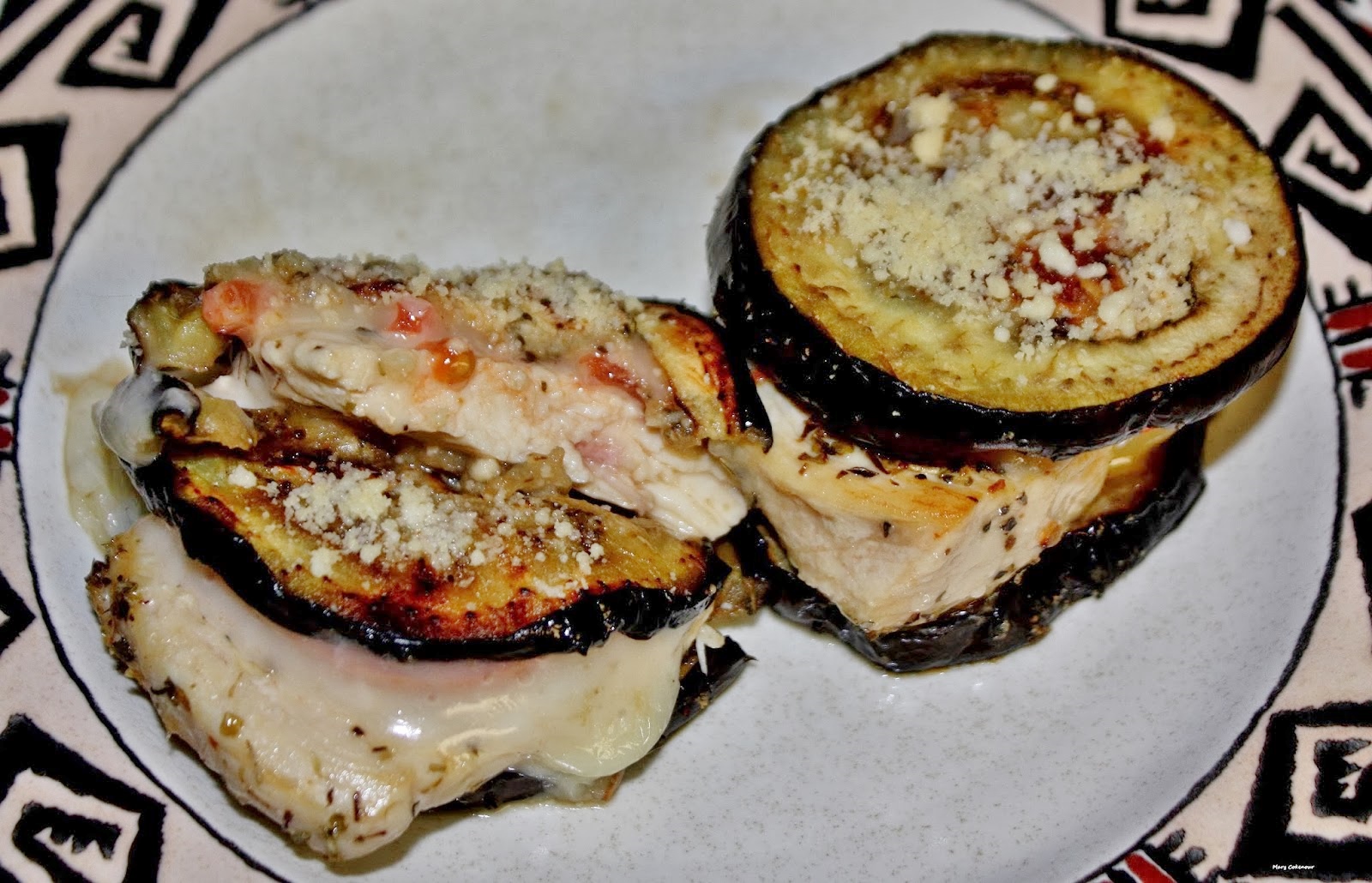


Eggplant-Chicken Bruschetta

Ingredients:

1 medium sized eggplant cut into 12 (1/4" thick) slices

3 tsp. salt

1 tsp. garlic powder

4 Tbsp. olive oil, divided in half

1 Tbsp. Italian herbal mix

6 pieces boneless, skinless chicken breasts (1/4" thick, cut to equal or slightly larger size than eggplant slices)

6 slices Roma tomatoes

6 slices mozzarella cheese

3 tsp. grated Parmesan cheese

Preparation:

Line a platter or baking sheet with paper towels; lay out eggplant slices, sprinkle with salt and cover with additional paper towels.  Wait a minimum of one hour before pressing the paper towels onto the eggplant to remove excess water that has been drawn out by the salt.

Heat 2 tablespoons of oil, medium-high heat, in a large skillet; place eggplant into skillet, brown one side, turn to brown other side and sprinkle garlic powder over first browned side.  Remove to paper towels.

Put remaining oil into skillet plus herbal mix; place chicken into skillet and brown both sides; remove to paper towels.  Preheat oven to 375F; line a baking sheet with aluminum foil.

Build a stack: eggplant slice, chicken piece, tomato slice, cheese slice, eggplant slice.  When all stacks are made, place on the baking sheet and top with 1/2 teaspoon of grated cheese.  Bake in oven for 5 to 7 minutes to allow mozzarella cheese to melt.

Makes 6 servings for an appetizer; Makes 3 servings for a meal.

Mary Cokenor

Wednesday, October 5, 2022

Giving the Devil His Due.

"I guess you didn't know it but I'm a fiddle player too

And if you'd care to take a dare, I'll make a bet with you

Now you play a pretty good fiddle, boy

But give the devil his due

I'll bet a fiddle of gold against your soul

'Cause I think I'm better than you" 

~The Devil Went Down to Georgia

Song by Charlie Daniels~

What does “give the devil his due” actually mean?  It is said when admitting that someone disliked, or seen as bad/evil, does have some good qualities after all.  Basically, it is about perspective, whether looked at from a pure objective viewpoint, or influenced by the viewpoint of others.

When it comes to the term “devil”, the connotations can be from the most extreme: evil, vile, foul, lakes of fire, brimstone and eternity of agony. To mild, as in “little devil” meaning mischievous and annoying, but hopefully will grow out of it.  While this normally relates to human beings, it is a whole other meaning when related to food. 

Travel back, with me, to ancient Rome and a traditional appetizer; eggs were boiled, seasoned with spicy sauces, and served at the beginning of meals.  In the novel, Satyricon, by Gaius Petronius, and written in late 1st century ADE, a wealthy Roman citizen throws a banquet.  The meat of songbirds is marinated in peppered egg yolks, then stuffed into the white part of boiled peahen eggs.  Eating all those eggs, no wonder the emperors and politicians were full of hot air; seems the norm for even today’s politicians. 

As the Roman empire expanded, the availability of unusual spices became more readily available.  Mustard, pepper, paprika were being mixed into the egg yolks, and stuffed into the empty cavity of the white.  A hot tomato sauce called Arrabbiata (Italian for “angry) was made with dried red chili peppers, and ladled over the stuffed eggs.

A 13th century cookbook, from the southern, Andalusian regions of Spain contained a recipe of grinding boiled egg yolks with cilantro, onion juice, pepper, and coriander with a fermented fish sauce.  It was the 18th century English though that coined the term “deviled” for fried or boiled eggs that were highly seasoned, in other words, fiery hot.   A mild food, the egg, converted to a concoction that would burn the tongue, must have been a creation of the devil himself!

In America, an 1896 cookbook was the first to mention using mayonnaise as a way to bind ground egg yolks, leading to today’s classic recipe containing mayonnaise, mustard, and paprika.  Of course, using the devil’s name, in a recipe, was looked upon as unholy, so simply renamed as stuffed eggs, dressed eggs, or Russian eggs (due to the use of paprika). 

One salad we enjoy is Deviled Egg Potato Salad, a mixture of the classical recipes of deviled eggs plus potato salad.  In the cookbook, The Mormon Pioneer Cookbook, 1995 edition, page 53 contains a recipe for this mixture, but is simply called, Hot Potato Salad.  Similar recipes appear in, What’s Cooking in Utah Kitchens, 1978, page 63, Potato Salad; and The Pioneer Cookbook, 2011, page 92, and also simply named, Potato Salad.

Well, I believe in giving credit where credit is due, and since I add cayenne pepper to my homemade salad, “devil” will be included in the name’s entirety.

Since All Hallows Eve, aka Halloween, is coming nye, perhaps serving up some of this salad, at your party, will keep all the demons and devils sated.


Deviled Egg Potato Salad

Ingredients: 

6 large russet potatoes, peeled, cubed, and cooked to fork tender.

6 large eggs, hard boiled, peeled, and chopped.

1 cup mayonnaise

½ tsp. sugar

1/8 cup white vinegar

3 Tbsp. yellow mustard

3 Tbsp. minced onion

2 Tbsp. sweet pickle relish

½ tsp. each of salt, ground black pepper, paprika and celery seed

1/8 tsp. ground cayenne pepper

Preparation: 

In a large bowl, mix all ingredients together thoroughly.  Can be served warm or cold.

Makes 8 servings.

Mary Cokenour


Wednesday, September 28, 2022

Be Creative with Your Second Harvest.

 As the cooling rains fall, the dust is washed away from every surface it touches.  The soil is pounded down while greedily sucking up every moist drop that it can contain.  Cold weather plants plead to live for one more month, while less resistant ones struggle to stay upright.  Yes, the season of autumn has taken the throne, and we must do its bidding.

The plants in our vegetable garden have granted us one more abundance for harvest.  The last picking of tomatoes, peppers, zucchini and yellow squash; and their mothering plants transferred to the compost bin.   Unfortunately, not enough for processing for winter storage, but enough to create salsa for this weekend’s anime marathon.  Plus, two meals popping with colors of green, red and yellow; Greek inspired vegetables, and a cheesy, vegetable loaded frittata.  I look at this as a prequel to when the leaves will be displaying their fall vibrant array.


Greek Inspired Vegetables

 Ingredients:

1 large zucchini

1 large yellow squash

1/8 cup olive oil

½ cup cherry tomatoes which were cut in half

1 tsp. crushed Greek oregano

½ tsp. ground black pepper

Feta cheese, crumbled

Preparation:

Preheat oven to 350F; line a baking sheet with aluminum foil.

Slice the zucchini and yellow squash diagonally, place on top of foil, in single layers.  Drizzle oil over slice, and bake for 20 minutes.

Remove vegetables to serving platter, top with tomatoes, and sprinkle with oregano and black pepper.  Sprinkle with crumbled Feta cheese, to taste (we like plenty of it!).

This can be served as a meal, serving two; or as a side dish

The next recipe is for a cheesy, veggie loaded frittata.  What is frittata? Frittata is an egg dish similar to an omelet or a crustless quiche.  It can contain ingredients such as meats, cheeses, vegetables or pasta, and can be flavored with herbs and/or spices.  A frittata can be baked, but is mainly made in a skillet. When started on a stove top the frittata can be finished off in an oven, under a broiler, or flipped and finished in the pan.  The flipping technique can be daunting, especially if attempting the “up in the air” flip.  The easiest way is to slide the frittata onto a large plate, place another plate over top, flip, and then slide back into the skillet.  Or place the skillet over the plate, and then flip it over, altogether.  Of course, with the second option, you have to be very careful doing it, as the skillet will be burning hot; oh, and remove the plate before finishing the cooking process.

Frittata preparation differs from omelet preparation in that the eggs are beaten with water, milk or cream to incorporate more air, where the eggs for omelets are less airy. The additional air in the frittata mixture allows for a deeper filling and a fluffier result. Additional ingredients are added to the pan after the egg mixture, and before the eggs are fully cooked.

A frittata is usually divided into slices, and while it can be served as a meal by itself, a salad, or other side dish, can be added.


Cheesy, Vegetable Loaded Frittata

Ingredients:

6 eggs

3 Tbsp half n’ half

3 Tbsp. butter

½ cup each julienned red bell pepper, green bell pepper; thinly sliced zucchini, and peeled, thinly sliced yellow squash

3/4 cup shredded sharp cheddar cheese

1 tsp. fresh, minced tarragon (used crushed, dried if fresh not available)

¼ tsp. salt

1/8 tsp. ground black pepper

Preparation:

In small bowl, whisk together eggs and half n’ half; set aside.

In a 10-inch, non-stick, skillet, on medium heat, melt butter and sauté all vegetables together, about 5 minutes; remove to bowl.   In same skillet, pour in egg mixture and let eggs cook for 5 minutes; do not stir. Distribute the vegetables, cheese, tarragon, salt and pepper evenly throughout the partially cooked eggs; let cook another 5 minutes.

Slide the frittata onto a plate, cover with another plate and flip over; slide it back into the skillet and let cook another 5 minutes. Slide frittata onto clean serving platter, cut into wedges, either 4 or 6, to serve.

 Makes 4-6 servings.

 Mary Cokenour

Wednesday, September 21, 2022

Oh My, She’s Baking Again.

It happens to be apple picking time, and remember my article, in The San Juan Record, May 18, 2022, about preserving apples for future usage?  One item happened to be homemade apple pie filling, chock full of cozy winter spices.

Now talking about cozy winter spices, another favorite is gingerbread, but the majority of bakers stick to decorated cookies, and creating artistic houses too pretty to eat.  In the Shrek movies, the poor little gingerbread man was constantly running from someone trying to eat him.  Well, I am going to pull a Marie Antoinette and say, “Let them eat cake!”

I have introduced author, Karen Rose Smith, to all of you once before.  She is a prolific writer of romance, and cozy mystery, novel series.  She lives in Hanover, Pennsylvania, and so, like I used to do, frequents the many farmers markets throughout Lancaster and York counties.  Hanover is famous for the pretzel company, Snyder’s, created in 1909 by baker, Harry Warehime.  From Hanover, it is only about a half hour ride to one of my favorite haunts (pun intended), Gettysburg National Cemetery and Park.

Back to Karen, while her Daisy’s Tea Garden mystery series takes place in Pennsylvania Amish country, namely Lancaster County; another series, Caprice De Luca mysteries takes place in York County.  I have read both, enjoyed both series, namely as it brings back very fond memories of my almost 20 years living in Lancaster, PA.

What has this to do with gingerbread?  Karen’s books, at their ending, contains a few recipes of dishes mentioned throughout each mystery, and here is one on gingerbread.


Apple Gingerbread

(Murder with Clotted Cream (A Daisy's Tea Garden Mystery Book 5) by Karen Rose Smith, page 309)   

Ingredients:

1 cup sour cream

¾ cup dark brown sugar

⅓ cup dark Karo syrup (substitutes =amounts molasses, maple syrup, honey)

¼ cup water

2 eggs

2 tsp. baking powder

1 tsp. baking soda

⅛ tsp. salt

2 tsp. ground cinnamon

2 tsp. ground ginger

2 and ½ cups flour

2 cups diced apples

Instructions:

Grease and flour two 8-inch cake pans (unless they are nonstick.)

Preheat oven to 350 degrees.

In mixer, beat sour cream, brown sugar, and Karo syrup. Add water.

Beat in eggs, baking powder, baking soda, salt, cinnamon, and ginger. Mix in flour little by little until batter is smooth.

Stir in apples and pour evenly into both cake pans.

Bake for 20 to 25 minutes until a toothpick poked into the center of each cake comes out clean.

Serve with a dollop of clotted or whipped cream.

What is clotted cream? 

Clotted cream is a thick cream made by indirectly heating full-cream cow's milk using steam or a water bath and then leaving it in shallow pans to cool slowly. During this time, the cream content rises to the surface and forms "clots" or "clouts", hence the name. It forms an essential part of a cream tea.  (Wikipedia definition)

Place of origin: England

Alternative names: Clouted cream, Cornish cream, Devonshire cream

Clotted cream is rich and sinfully decadent.  If you cannot find it in a store, I suggest online shopping at the English Tea Store (https://www.englishteastore.com/) for all items of the British realm.  Browse through the various departments, and a whole new world of culinary adventure awaits you!


Oh, so back to that apple pie filling I told you how to make; or used store bought, but spice it up with more cinnamon; cloves are nice, maybe a dash of cardamom.  After putting the cake batter together, first spread out the pie filling on the bottom of the pan, then spread the batter over it.  Let it cool completely, loosen the sides of the cake, and flip it out onto a serving dish…Upside Down Apple Gingerbread Cake!

Between the scent and the taste, you will have a warm fuzzy feeling throughout, and might not even need a blanket to feel cozy as the outside temperature begins to cool.

Mary Cokenour

Wednesday, September 14, 2022

Reversal of Fortune, Butter into Cream.

 “If you’re afraid of butter, use cream."

 "The only real stumbling block is fear of failure. In cooking you've got to have a what-the-hell attitude."

 Quotes from the famous master chef, Julia Child


Depending on the recipe, there are often times that cream, whether half n’ half or heavy, can be substituted for butter.  Then again, what is butter, but emulsified fat globules from the churning of milk or cream. In using cream, there is a satisfying smoothness that coats the tongue, whereas butter can be an unsatisfactory oil.

One of my favorite recipes is piccata which, in Italian, translates to “larded”.  It is a technique where chicken or firm fish is sliced thin, coated in flour, browned in oil, and finished off in a sauce of butter, lemon juice, and capers.  What are capers? They are berries that have a lemon tang, yet the flavor of olives that have been brined, aka salty.  They are more often found in Mediterranean and Middle Eastern recipes, since they grow primarily in those areas.

However, in France, piccata refers to the word “pique” which means “sharp”, and the sauce is made with butter, lemon juice and spices; no capers. The cooking style of dredging in flour and frying though is the same.  So, whether you travel to Italy or France, definitely try piccata, but expect a sincere difference in sauces.

Now, I am not afraid of butter, as Julia Child’s quote might imply, but I do enjoy experimenting in the kitchen.  I believe most of my experiments come from, “I have this (insert name of food item) in the fridge or pantry, and I wonder what would happen if I substituted it for…?”  It is a curiosity behavior inherent in the human psyche.  How else would we have all our modern benefits, such as the wheel, exist, if we were not curious beings?

So, instead of traditional butter, and a couple of minor adjustments, my chicken piccata found itself draped in a creamy lemon sauce.  As side dishes, I took a 16-ounce bag of frozen California Mix vegetables, added a cup each of julienned bell peppers (more colors the prettier it looks) and onions.  The vegetables were stir-fried in two tablespoons of olive oil, seasoned with salt, ground black pepper and a couple of dashes of garlic powder.

The other side dish was a saffron rice; 2 cups of rice, cooked in 4 cups of chicken broth with 10 strands of saffron.   What is saffron?  A spice collected from the saffron crocus; the threads/strands are the stigma.  The taste is sweet and floral while saffron that tastes bitter, metallic, or plastic-like are cheap imitations that should be avoided.  This spice is rather expensive, so a substitute for the 10 threads is ½ teaspoon turmeric plus ½ teaspoon paprika.  The use of chicken broth diluted the saffron’s red color, so the rice allowed the vegetables to pop their colors on the plate, yet was still a delicious addition.

In one month’s time, I needed to make this dish twice, as Roy became addicted to it.  The tanginess of the lemon, the smoothness of the creamy sauce; oh yes, you will want to lick that plate clean!  Not telling if Roy did that, I will just leave it to your imagination.


Meals becoming a little boring, or need a wow factor for guests?  Try Chicken in Creamy Lemon Sauce, and wake up your, and everyone else’s, taste buds.


Chicken in Creamy Lemon Sauce

 Ingredients:

4 boneless, skinless chicken breasts, cut in half lengthwise

1 tsp. salt

½ tsp. ground black pepper

2 Tbsp. paprika

3 Tbsp. olive oil

1/3 cup white wine vinegar

1/3 cup lemon juice

¼ cup chicken stock

1 Tbsp. flour

1 cup half n’ half

Preparation:

 Mix together salt, pepper and paprika and season one side of the split chicken breasts.  Heat olive oil, medium-high heat, in large skillet, and brown chicken, 5 minutes, on both sides.  Add vinegar and lemon juice, cover skillet and let simmer for 5 minutes.  Remove chicken to plate.


Raise heat to high, add chicken stock and flour, whisk till smooth. Add half n’ half, bring to boil; whisk until smooth and creamy.  Spoon sauce over chicken.

Makes 8 servings.

Mary Cokenour