Wednesday, June 1, 2022

Three Countries Influence Creation of One Recipe.

 When it comes to food, it seems that more peaceful moments are shared around the dining table.  Picture it, 1840s, France brings thinly sliced veal, covered in breadcrumbs and fried to a crisp, golden brown.  Russia cannot afford veal, but chicken is plentiful, so they decide to do the same style of cooking to chicken breasts.  Germany simply sits there, a smirk on the face, and declares, “You have copied our Schnitzel!” 

But wait, time warp jump to the left, then take a step to the right, and we are in the 1940s.  Since Switzerland is a neutral country, during World War 2, it is not suffering the same food shortages, and horrors, of the war.  Switzerland is a mixture of four origins: German, French, Italian, and Romansh (official national language of the Swiss), and with languages comes culture and cuisines.  They took the “schnitzel style” meat, layered ham and cheese on top of the chicken, rolled it, and then deep fried it.  The word “bleu” refers to “blue ribbon” which was a wide blue ribbon, worn by the members of the highest order of the French knighthood, L’Ordre des chevaliers du Saint-Esprit, since the year 1578.  Basically, the Swiss took creative license, with what we know as Chicken Cordon Bleu, from the influences of France, Russia and Germany.

The first reference of this recipe, in America, was in the New York Times, 1967.  However, American cookbooks, chefs and home cooks were already making their own versions.  The addition of Dijon mustard gave it more of a French flair, while Alfredo sauce gave the Italians a hold of the plate.  However, the cheese was still Swiss, and bleu cheese was only in side salads.

Then comes along this home cook, and she decided to make a complete meal, including vegetable, in one pot, a crock pot.  My invention is the Chicken Cordon Bleu Casserole.  I still used chicken and Swiss cheese, but paid homage to Germany by using Black Forest Ham.  This type of ham has blackened skin and light, smoky flavor.  The blackened skin comes from the spices (salt, garlic, coriander, juniper and pepper) that is applied, and smoked over pine or fir.  The process takes up to three months, and the origin is, of course, from the Black Forest area of Germany.

Side note; if you have never visited Germany, I highly recommend a visit to the beautiful city of Munich, and the Black Forest.  Then take a side trip, only five hours east, to the Bavaria Alps, and visit Neuschwanstein Castle, home of the Mad King, Ludwig.  Back to the recipe…

I did Americanize the recipe by using cornbread stuffing, for a southern touch, and using “cream of” soups for convenience.  This is a layered casserole, but cooks up completely in only four hours, on a low setting.  While enjoying your meal, let your mind wander off to Europe and visit all the countries that inspired the original recipe.


Chicken Cordon Bleu Casserole


Ingredients:

4 boneless, skinless chicken breasts, trimmed of fat, cut in half width wise

½ tsp. coarse sea salt

½ tsp. ground black pepper

1 Tbsp. paprika

8 slices Swiss cheese

8 slices Black Forest Ham

1 (12 oz.) bag cornbread stuffing

1 (10.5 oz.) can cream of celery soup

1 (10.5 oz.) can cream of chicken soup

2 cups milk

1 Tbsp. Dijon mustard

1 tsp. celery seed

1 (12 oz.) bag frozen, cut green beans, thawed

Preparation:


Spray interior of 6-quart crock pot with nonstick cooking spray.  Layer chicken over bottom.  In a small bowl, mix together salt, pepper and paprika; sprinkle over chicken.


Layer cheese over chicken, ham over the cheese, then stuffing over the ham.  In large bowl, whisk together soups, milk, mustard, and celery seed till smooth and well combined; pour over stuffing.  Spread out green beans over the sauce.


Cover crock pot, set to low, and meal will be completely cooked in four hours.

Makes 8 servings.

Mary Cokenour 


Wednesday, May 25, 2022

To Be or Not to Be Caffeinated.

 According to the Farmer’s Almanac, the summer of 2022 is going to be a scorcher all over the US of A.  Fans and air conditioners will be working overtime, so do not be surprised when electrical grids going down becomes a habit.  Besides craving cool air, most of us will be craving cold beverages to bring body temperatures down.

Iced coffee, iced tea, lemonade, soda, water, flavored carbonated water, aka seltzer water, and soda will be the go-tos.  Better keep those freezers stocked with trays of ice though; they will keep if the freezer is not opened too often with a power outage.  Then I got to thinking, dangerous, I know, about these cold drinks that contain caffeine, and how they affect body temperature.


First off, how does caffeine work in the body?  Researchers from the Linus Pauling Institute at Oregon State University in Corvallis, wrote in Critical Reviews in Food Science and Nutrition (March 2006): “Coffee drinking may help prevent type 2 diabetes, Parkinson's disease, and liver disease, including liver cancer. And it doesn't appear to significantly increase heart disease risk or cancer.  Caffeine can improve memory, decrease fatigue, improve your mental functioning; it can improve your short-term memory and speed up your reaction times.”

I have been a coffee and tea drinker since my university years.  Getting up at 5am, to catch a Long Island Railroad train to New York City, it was not unusual to see most folks with a New York Times or New York Post inserted under the arm.  In one hand was a brief case, or book bag for students, and a cup of steaming coffee or tea in the other.  Once into Manhattan, lining up at the local deli was the norm, to get a breakfast sandwich, and you guessed it, another cup of coffee.  This was the city life of an “early bird”.  After finishing university, it was off to work in the city, and the morning routine did not change much.  During the sweltering summer months though, hot coffee or tea was replaced by iced, or soda; bottled water was not a fad yet in the 1970s and 1980s.

Now what is the downside to caffeine?  It does raise blood pressure, and while mildly, for some, that is enough to cause harm.  Increased blood pressure, plus stress from ordinary life, equals heart disease just waiting to take over.  Remember that study I quoted before?  Coffee itself may not increase heart disease itself, but your lifestyle could be the contributing factor that activates it.

Caffeine is also, like anything else in reality, addictive; it will cause anxiety, insomnia, and overall stimulation of the brain.  Stopping cold turkey?  A person will go through withdrawal symptoms similar to alcoholics or drug users.


By the way, how do I like my coffee?  I have a favorite mug that holds up to 2 cups of liquid.  First, I put in a teaspoon, maybe two, of sweetener.   


Second is a ¼ cup of creamer or half n’ half.  


Third is the fun part; as the coffee is poured in, it mixes with the sweetener and cream to create this lovely, frothy mocha colored, drinkable confection.


So, you have decided to avoid caffeine altogether by avoiding drinks containing it.  What about food though; do you know exactly what contains caffeine?  It is naturally found in tea leaves, cocoa beans, coffee beans, guarana, and kola nuts.  Yerma Mate, a popular health food item, contains it, as well as green tea which is good for digestion.  But a fan favorite is chocolate!


How much caffeine is in 3.5 ounces (100 grams) of different types of chocolate?


    100% cocoa chocolate: 240 mg of caffeine — the equivalent of 2.5 cups of regular coffee

    Bittersweet chocolate (55% cocoa): 124 mg of caffeine

    Milk chocolate (33% cocoa): 45 mg of caffeine — around the amount of caffeine in a cup of        

                 black tea

    White chocolate – only contains cocoa butter with 0% caffeine

All in all, what you put inside your body, whether as a food or beverage, is a personal choice.  As with any item, moderation is the best gamble.  Have questions?  Research by reading, asking others about their experiences, and, perhaps, do some experimenting of your own.  What can happen?  You will definitely find out what suits you, amount and taste wise, the best.  Like I said, personal choice. I drink coffee and tea, hot and cold; I eat chocolate, but you won’t ever find me spitting tobacco juice on a clean floor.  Personal choice.

…and for those wanting a recipe containing coffee and chocolate, I did not forget about you.


Coffee Kisses

These cookies can be made with espresso, a flavored coffee made strong, or Kahlua (the alcohol will bake off, and just leave the coffee flavor).

Ingredients:

½ cup softened butter

1 cup sugar

2 eggs

5 Tbsp. coffee or Kahlua

2 cups flour

2 Tbsp. unsweetened cocoa powder

¾ tsp. baking powder

Hershey chocolate kisses

 Preparation:

Preheat oven to 375F. Use nonstick baking sheets, or spray with nonstick baking spray (contains flour).

In a large bowl, cream together the butter and sugar until smooth; add eggs one at a time, then the coffee; mix until smooth and creamy.

In another bowl, sift together the flour, cocoa and baking powder; add to the creamed mixture and mix thoroughly.

Use a teaspoon to place mixture onto cookie sheets; bake for 10 minutes. While still hot, insert a chocolate kiss into center of each cookie. Let cool.

Makes 2 dozen cookies.

Mary Cokenour


Wednesday, May 18, 2022

Freeze it Now to Enjoy Later.

Now every home cook and baker have come to this point in time.  A recipe is found that seems to be a must-do.  The ingredient list is short, the preparation is simple enough, and then it hits.  As the gathering of ingredients begins, holy moly, I am out of…?  For the majority of folks, hopping into a vehicle, or walking a few streets, gets us to a food store.  Nowadays though, when we get there, what are we finding?  Either the shelves have been emptied due to a multitude of reasons that boggle the mind, or the prices have super inflated suddenly.

Alright, once again, I still feel that we are all being pushed to practice self-sufficiency, and making America self-sustaining.  I will not apologize for repeating this, as my goal is to get people to think outside of their cozy little box.  Think of it this way, growing, processing and storing your own food is certainly more tangible than cryptocurrency which is based on faith, and nothing concrete.

Apples, I do not know anyone who does not enjoy a good, crisp apple to munch on.  The varieties seem to be increasing yearly with enticing names such as Cosmic Crisp, Pink Lady, Envy or even to make us imagine a trip far away…Rome.  Each apple has its use in the cooking/baking world dependent upon sweet/sour/tart, or texture such as firm/crisp/semi-firm.  Depending upon a recipe, some call for a specific type, such as Granny Smith is the ultimate pie making apple, to Gala or Braeburn for cake baking.

Back to how to avoid not having availability.  While many can do canning, not everyone has the want to do, or the storage space to have, jars of preserved goods.  I have mentioned dehydration in a few past articles, but it is timely, and dehydrators may be pricey.  Freezers though are a great investment for food storage; whether it is vegetables, fruits, processed hunting game, or even baked goods.  Wrapped appropriately, labeled and dated, many items can last six months to one year.

So, how can apples be frozen?  When peeling apples, metal upon the fruit will begin an oxidation process, and brown spots or mottling will begin.  Make sure to have a bowl of cold water plus lemon juice readily available (1/4 cup lemon juice to every gallon of water).  Core the apples, peel and either chop into small to medium chunks, or slice thinly.  Make sure to have a plan of attack…what do you need, for what recipe? 


When done, drain the apples and spread them across a pan, lined with wax paper; make sure they are in a single layer.  Freeze for one hour, peel off the wax paper and drop into a freezer bag that has been labeled and dated.  Seal the bag, and squeeze out as much air as possible; the bags can be stacked, in the freezer.  When the apples are needed, use frozen, but your baked good might take longer to make; or thaw in the fridge.  Do not drain any excess water, that’s good apple flavor right there, so adjust liquid in the recipe itself.   


Need apple pie filling?  Slice the apples, mix with sugar and spices, and freeze directly inside a gallon sized bag.


Alright, now you are saying, “But Mary, summer is almost here and who is really thinking about baking in the heat?”  Imagine, it is hot, you have just finished mowing the lawn, you just want something cold.  How about popping a couple of frozen apple chunks into your mouth?  As they thaw, from the heat of your own body, the cool liquid flows and the taste of apple makes you smile.  Pop some of those apple chunks into your iced tea, instead of ice cubes; they will not water down your drink, and you have a little snack to boot.

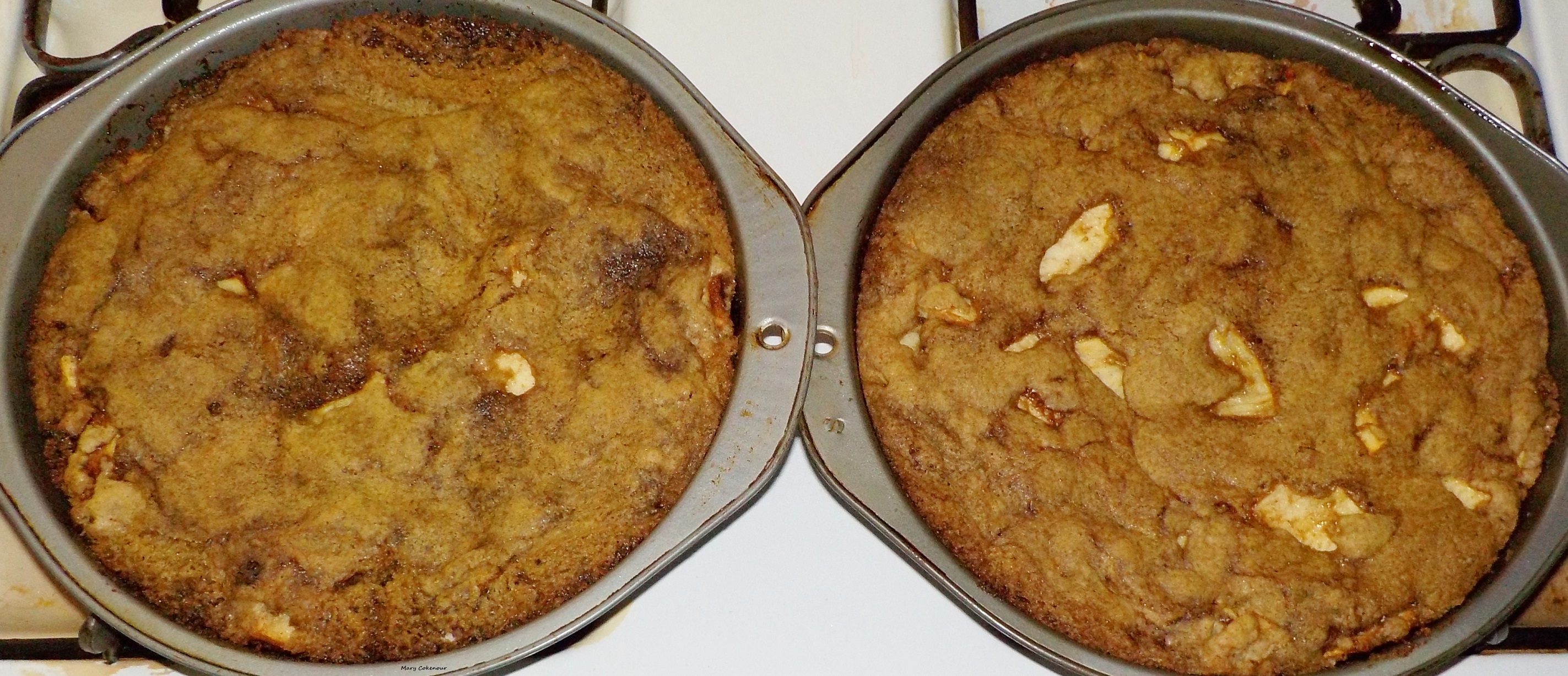
Now here’s an apple cake recipe; one bowl, two baking pans, and you can freeze them for up to 3 months.  Easy-peasy 1-2-3!


One Bowl Apple Cake


 Ingredients:

2 large eggs

1 and ¾ cups sugar (or equivalent in sugar substitute)

3 tsp. cinnamon

1 tsp. nutmeg

½ cup canola oil

1 and ½ lbs. (about 6 medium size) apples (Gala or Braeburn are my choice)

2 cups all-purpose flour (high altitude, add 3 Tbsp.)

2 tsp. baking soda

Preparation:

Preheat oven to 350F.  Spray 2–9-inch baking pans with non-stick baking spray.


In a large bowl, whisk together eggs, sugar, cinnamon, nutmeg and oil.  After coring, peeling and slicing each apple, add immediately into bowl, and coat with liquid mixture.


Sift together flour and baking soda; mix gently into the apples until thoroughly incorporated.


Divide between the two baking pans; bake for 50-55 minutes, or until a toothpick comes out cleanly from center.


Makes two cakes.

Notes:

I am terrible at dividing up between pans, so used two bowls, putting half of each item into each bowl. 

Storage:  In refrigerator, wrap in plastic, or place inside plastic storage bag.  In freezer, wrap tightly inside two layers of plastic wrap; label, date and will last up to 3 months.  Thaw in refrigerator.

These cakes, whether freshly eaten, or after thawing from freezer, are moist, full of spicy apple flavor, and have the texture of a streusel coffee cake without having to use a brown sugar topping.

Mary Cokenour


Wednesday, May 11, 2022

The Poof is in the Honey.

 The watering stations, in the backyard, are beginning to see more activity.  Honey bees are finding their way back, with flowering plum and apricot trees to provide pollen as well.  Around the stations are a plenitude of flowering, what some call weeds, but are pretty flowers to me.  The bees do not complain, so why should I?

I am hoping that some of these bees are relatives of the ones saved in June 2020.  Cindy and Mack Smith helped rescue, and introduce, them into their existing hives.  Since then, the Smiths have given us a jar of their precious, and most delicious honey each year; and we are so very grateful for the generosity.

In our home, the honey is never wasted as it sweetens are tea, is used for cooking, and most definitely for baking, especially bread products.  When baking up bread, even rolls, that require yeast, some sort of food is needed to feed the yeast, a sweet food.  Most recipes call for sugar, but, in comparison, honey makes it more flavorful, and sugar is, well, sort of bland.  Now many will agree, and many will disagree, and that is perfectly alright as taste is in the mouth of the person eating.  However, I know many who will drizzle honey over their sugar infused bread, and they are making my point, honey makes it better!

As I have stated many times, I like it easy; easy recipes, easy preparation, and easy techniques.  Recently I came across a recipe for 5-Ingredient Bread with the yeast being fed by honey…perfect for me!  While it makes an airy white bread, I played with the recipe and introduced potato flour to the all-purpose flour.  The first batch was terrible.  While the outside was crusty and golden brown, the interior was a complete mushy mesh.  What went wrong? 

Potato flour is not the same as boiled, mashed potatoes apparently, even though the flour is made from, what else, potatoes.  Potato flour is made from potatoes that have been cooked, dried to remove all water, then ground; however, it retains the starch.  Adding mashed, wet potatoes means it is retaining the starch which makes the bread denser, but liquid has to be limited.  Potato flour sucks up water like a sponge, so additional water needs to be constantly added to the mixture for a dough to eventually form.  Too much water though, and the bread will bake on the outside, but leave a wet mess inside.  It seems to be a matter of trial and error.

How to fix this?  For every 3 complete cups of all-purpose flour, only add ¼ cup of potato flour.

Back to the honey.  While waiting for the yeast to grow inside the mixture of warm water and honey, expect to be amazed.  In 15-20 minutes, the entire mixture will simply grow and grow!  I used a 4-cup bowl, and good thing a clean towel was over it, as the mixture had doubled and would have been dripping over the sides.  Oh, and the smell of the yeast and honey is intoxicating!

Now to the recipe; try it as written, but I definitely suggest adding a little potato flour to the mixture.  The bread will be slightly denser, so you will think you are eating cake, instead of bread.  As is, or with butter smeared over, is lovely. Toasted, with butter and jam, jelly or marmalade, now we are talking heavenly.


5-Ingredient Bread

Ingredients:

2 cups warm water (105F-110F)

2/3 cup honey

1 and ¾ Tbsp. active dry yeast

1 and ½ tsp. salt

5 cups all-purpose flour (or 4 and ½ cups all-purpose plus ¼ cup potato flour)


Preparation: 

In a large mixing bowl, whisk together warm water and honey until honey is dissolved. Add yeast, and cover with a towel. In about 10-20 minutes, mixture will be frothy and double in size.


Stir in salt, and add flour one cup at a time.  Flour hands, remove dough to board, or clean counter, and knead for 5 minutes. Place kneaded dough in a large, greased bowl and cover with towel.

After an hour, dough should have risen to almost top of bowl. Punch the dough down once, remove to board or clean count; knead again for 5 minutes. Divide into two lightly-greased loaf pans, cover with towel; allow dough to rise for 30 minutes.

Bake in a preheated oven at 325F for 30-35 minutes. Many bread recipes use an oven at 350F, but 325F works better when using honey.

 Makes two loaves.


To freeze a loaf, wrap completely in plastic wrap, place inside a freezer type plastic bag, and label with date as it will only keep for 3 months.  That is if it can last that long before both loaves are eaten.

Enjoy baking and eating this bread, and remember to always be kind to the bees.

Mary Cokenour